SUBSCRIBE! Sign up for our daily newsletter and never miss a story!

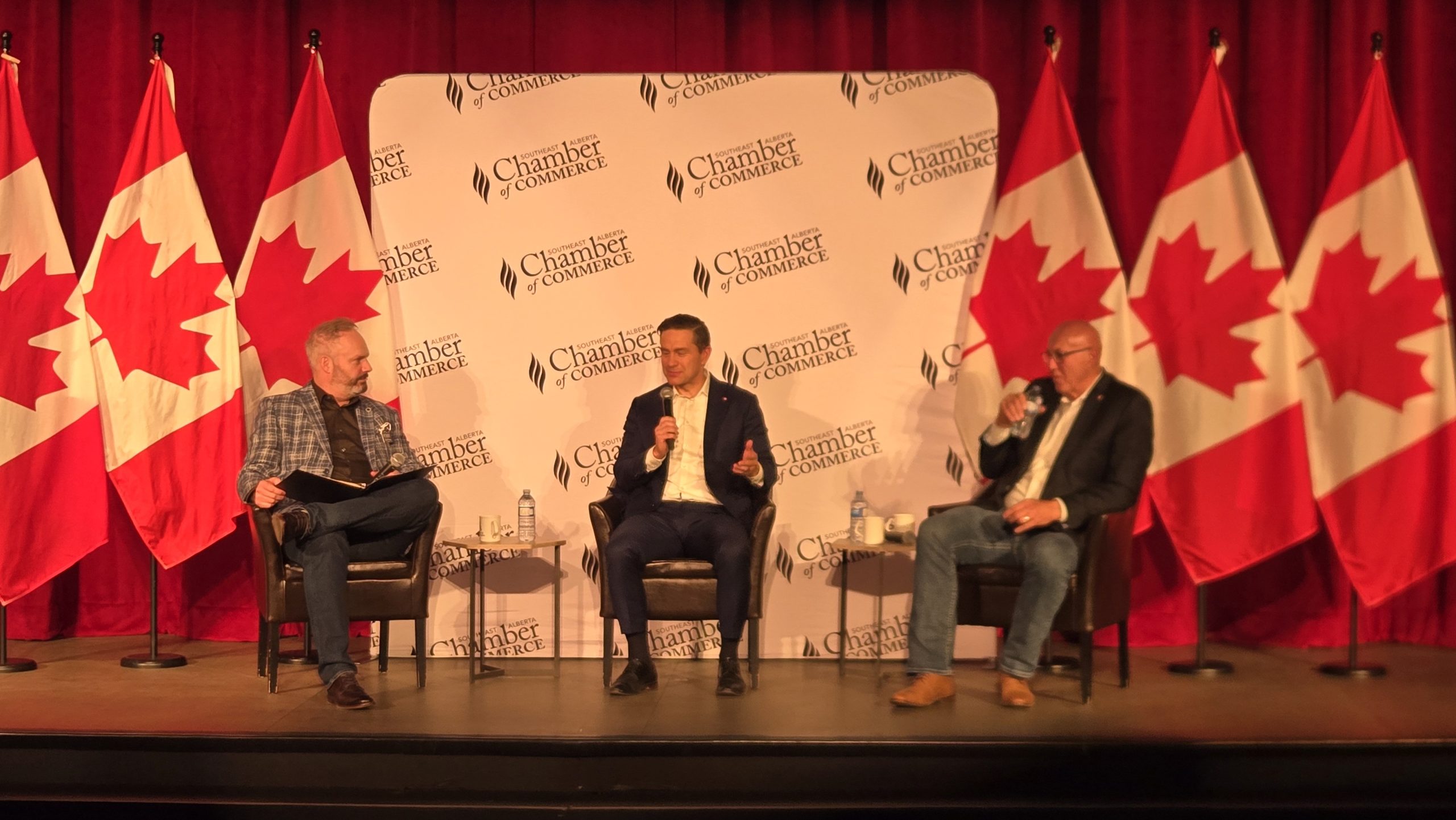
Left: SEACOC President Aaron Fleming. Middle: Conservative Leader Pierre Poilievre. Right: MP Glen Motz (Image Credit: Jett Schwaier/CHAT News)
trade, taxes, infrastructure, energy and workforce

VIDEO: Poilievre outlines economic priorities at Medicine Hat town hall

Oct 1, 2026 | 10:52 PM

Conservative Leader Pierre Poilievre spoke about the future of Canadian business, investment and economic competitiveness on Thursday during a town hall at Medicine Hat College.

The event, hosted by the Southeast Alberta Chamber of Commerce and Medicine Hat-Cardston-Warner MP Glen Motz, brought business leaders, entrepreneurs, professionals, community leaders and residents together for a discussion about issues affecting Canada’s economy.

The chamber said the event was intended to give members of the business community an opportunity to hear directly from a federal political leader and ask questions about issues including workforce availability, housing, regulatory efficiency, infrastructure, trade, agriculture, energy development, transportation and the cost of doing business.

Poilievre used his opening remarks to outline his views on the cost of living, government spending, resource development, taxation and Canada’s business environment.


He said his party’s focus is on reducing costs, creating jobs, improving public safety, addressing flaws in the immigration system and putting Canada first.

Poilievre argued that government spending and the growth of the money supply have contributed to higher costs and reduced Canadians’ purchasing power, saying reducing government spending would require cuts to bureaucracy, consultants, foreign aid and what he described as corporate welfare.

He also called for lower taxes for businesses and fewer regulatory barriers to investment, particularly in the energy sector.

Poilievre said Canada should increase oil and gas production and make it easier to build infrastructure to move Canadian resources to domestic and international markets.

He added the federal government should focus its permitting authority on projects that cross provincial borders, while projects located entirely within one province should be handled by that province.

Also, Poilievre called for changes to federal environmental and tanker legislation and faster permitting for major projects, saying a quicker approval system would unlock investment and help businesses build projects faster.

Poilievre spoke about government spending and Canada’s debt, saying the federal government should cut what he described as unnecessary spending and introduce stricter rules on new expenditures; he also said a Conservative government would change the tax system to make it easier for small businesses to operate and invest.

—


(Video Credit: Jett Schwaier/CHAT News)

—

During the question-and-answer portion, Poilievre was asked about Canada’s relationship with the United States and the ongoing tariff dispute.

He said he recently travelled to the U.S. and spoke with American media, Democrats and Republicans, as well as former White House economic adviser Larry Kudlow.

Poilievre said he did not directly engage with the U.S. administration, as Canada has “one prime minister at a time” and that the federal government should be responsible for negotiations with the American administration.

He said the conversations he had in the U.S. showed support for maintaining strong economic ties between the two countries and argued Canada should seek tariff-free access to the U.S. market while also diversifying its international trade relationships.

Poilievre said Canada has free-trade agreements with countries around the world, but argued that agreements are of limited value if Canadian businesses can not get their products to international markets.

He pointed to infrastructure and permitting as barriers to getting Canadian resources to customers, using Germany’s construction of a liquefied natural gas terminal as an example of what he described as a faster approval process.

The discussion also included internal trade between provinces.

Poilievre said provinces should mutually recognize product safety approvals, allowing a business that has already met the requirements in one province to sell its products across the country without going through another approval process.

He also said Canada should make it easier for workers to move between provinces and for consumers to purchase certain products across provincial borders.

Infrastructure was another major topic, with Poilievre calling for improvements to ports, railways and interprovincial highways to help businesses move goods more efficiently.

Poilievre pointed to a proposed rail connection between Oyen and Edmonton as an example, saying it could eliminate a longer route for farmers.

“Farmers have to ship all the way to Saskatchewan to get to British Columbia,” Poilievre said at the town hall.

“Just so some people might not realize that Saskatchewan is not on the way to British Columbia from Alberta. But to get rid of the backtracking, we need a direct line through Edmonton and then west to the Pacific.”

Poilievre also returned to the issue of project approvals, saying one level of government should be responsible for permitting a project within a province rather than having multiple governments review the same project.

He highlighted a one-year maximum for federal project approvals, with a six-month target, and said areas could be designated as “shovel-ready” zones to give businesses greater certainty.

Poilievre pointed to Hardisty, Alta., as an example of what he described as an efficient permitting system and highlighted the community’s importance to Canada’s energy industry.

Government spending and financial accountability were also raised, with Poilievre saying he would change the federal government’s accounting system and introduce a rule requiring new spending to be matched by savings elsewhere.

He was also asked about natural health products and said he supports Bill C-224, arguing that natural health products should face fewer regulatory restrictions and be treated more similarly to food products.

For small and medium-sized businesses, Poilievre said governments should focus on removing obstacles rather than creating subsidy programs, and supports allowing Canadian investors to roll capital gains into other Canadian investments and simplifying the tax system for small businesses.

The discussion also turned to rural economies and agriculture.

Poilievre said affordable fuel is particularly important for rural communities, where farmers and businesses often move products long distances and rely on large amounts of equipment.

When asked whether the federal government could shield Canadians from global fluctuations in fuel prices, Poilievre said increasing Canadian oil production could strengthen the Canadian dollar and provide some protection against global oil-price changes.

He also argued that Canada should increase domestic refining, storage and transportation capacity so Canadian consumers and businesses are less dependent on foreign refineries for finished fuel products.

Workforce shortages and labour mobility were among the final topics discussed.

Poilievre said his party would seek to reduce the temporary foreign worker program and prioritize Canadian workers, while maintaining a separate agricultural program for farms that cannot find enough Canadian workers.

He encouraged more young people to enter the skilled trades and said a Conservative government would provide high school principals with resources to help students enter apprenticeships before they graduate.

Poilievre also proposed a national professional licensing standard for doctors and nurses, arguing that qualified professionals can face barriers when trying to practise in Canada or move between provinces.

He said a national standard could make it easier for qualified professionals to enter the workforce.

Poilievre also called for lower income taxes and changes to benefit clawbacks, saying the tax system should provide a greater financial incentive for people to work additional hours, earn bonuses or take on higher-paying jobs.