SUBSCRIBE! Sign up for our daily newsletter and never miss a story!

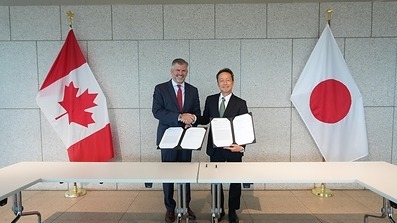
Landing Zone Canada CEO Spencer Fraser and a representative from Japan's Meisei Electric Co. (Image Credit: Landing Zones Canada Inc.)
Landing Zones Canada Inc.

Medicine Hat aerospace company signs deal with Japanese firm for stratospheric testing

Oct 1, 2026 | 9:39 AM

A Medicine Hat aerospace company and a Japanese technology firm have signed an agreement to jointly test stratospheric aircraft technology in Canada, with initial trials planned for Alberta and the Arctic this fall.

Medicine Hat-based Landing Zones Canada Inc. and Japan’s Meisei Electric Co. Ltd. signed the International Project Consortium Agreement Thursday at the Embassy of Canada to Japan in Tokyo.

The agreement will see Landing Zones Canada’s Eagle remotely piloted aircraft system integrated with Meisei’s ultra-compact stratospheric observation platform.

The companies said they plan to conduct joint flight campaigns in Canada over the next three years, including high-altitude deployment and recovery trials and testing reusable observation and communications payloads.


The technology is expected to be evaluated for applications including meteorological observation, disaster response and security.

More extensive flight campaigns will follow the initial trials.

Landing Zones Canada CEO Spencer Fraser said the agreement builds on a broader Canada-Japan partnership announced earlier this year.

“This IPCA is more than a company-to-company agreement. It gives practical effect to the partnership Prime Minister Carney and Prime Minister Takaichi set in motion earlier this year,” Fraser said in a statement.

“Meisei has world-class stratospheric balloon technology, and we look forward to integrating it with LZC’s world-class high-altitude, recoverable Eagle remotely piloted aircraft system.”

Meisei President and Representative Director Masanobu Natsuake said the collaboration could expand the use of stratospheric technology in areas such as weather monitoring and disaster prevention.

“This collaboration is an important step toward opening new possibilities in meteorological observation, disaster prevention, and aerospace technology through stratospheric demonstrations in Canadian airspace,” Natsuake said in a statement.

“We are confident that combining Meisei’s Stratospheric Platform with LZC’s technologies for deploying uncrewed aircraft from the stratosphere and operating at high altitude will create significant value. We hope this project will support the safe and sustainable use of the stratosphere and further strengthen the friendship and partnership between Canada and Japan,” he added.

“Meisei will pursue responsible technology development and safe demonstration activities while placing great importance on its relationship of trust with LZC.”

The companies said the agreement is one of the industry initiatives intended to advance the Comprehensive Strategic Partnership signed March 6 by Canadian Prime Minister Mark Carney and Japanese Prime Minister Sanae Takaichi.

According to the companies, that partnership identified defence and security, advanced technology and innovation as areas for deeper co-operation.

Landing Zones Canada develops and manufactures uncrewed aircraft systems and related technology for civilian environmental protection and security applications. The company operates in Medicine Hat and Ontario.

Meisei Electric develops meteorological and environmental observation technology, including radiosondes, ground-based weather networks, stratospheric platforms and space-borne sensors.