SUBSCRIBE! Sign up for our daily newsletter and never miss a story!

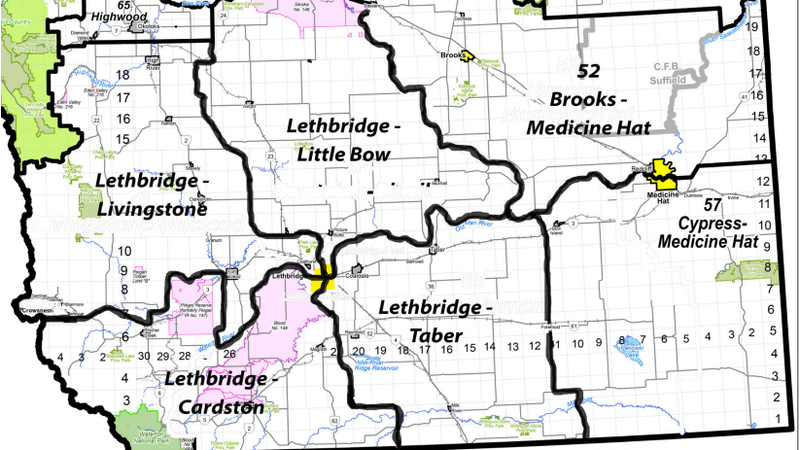
The proposed provincial electoral boundaries for southern Alberta. (Image: Alberta Electoral Boundaries Commission)
PROVINCIAL ELECTORAL BOUNDARIES

Proposal to redraw southwestern Alberta into four rural-urban provincial ridings

Aug 14, 2025 | 12:22 PM

Opinions appear to be divided on the newly-proposed electoral boundaries in southern Alberta.

The Alberta Electoral Boundaries Commission (ABEBC) is currently reviewing the provincial electoral districts, as it is required to do every two general election cycles.

Currently, southwestern Alberta is served by MLAs who represent Lethbridge-West, Lethbridge-East, Cardston-Siksika, Livingstone-Macleod, and Taber-Warner. The two Lethbridge ridings are entirely urban, while the other four cover the surrounding rural communities.

The new proposal aims to create rural-urban hybrid ridings that split Lethbridge into four districts, and each would include a large rural area.
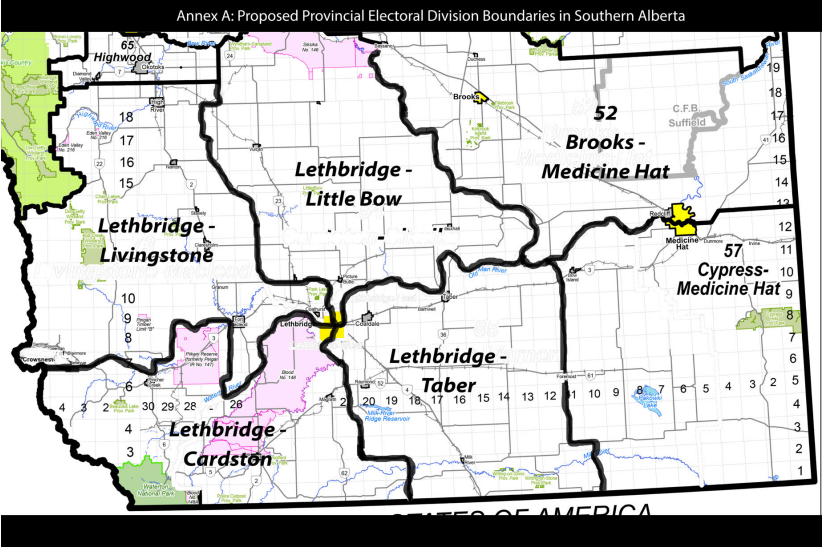
The proposed provincial electoral boundaries for southern Alberta. (Image: Alberta Electoral Boundaries Commission)
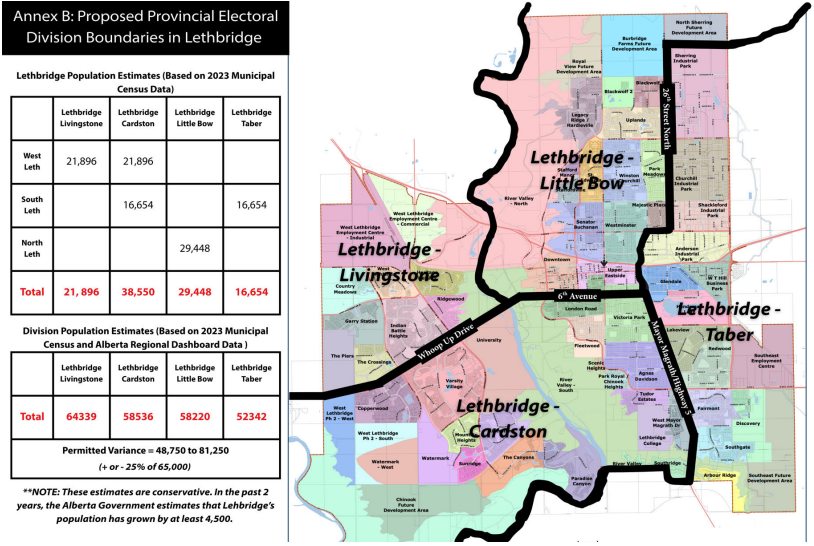
How Lethbridge would be divided into new provincial electoral boundaries under the proposal. (Image: Alberta Electoral Boundaries Commission)

Lethbridge-Little Bow

  • Would include downtown Lethbridge and areas of north Lethbridge to the west of 26 Street North
  • Would include communities such as Picture Butte, Vauxhall, Vulcan, and the Siksika First Nation
  • Estimated population as of 2023: 58,220

Lethbridge-Taber

  • Would include areas in south Lethbridge to the east of Mayor Magrath Drive South and east of 26 Street North
  • Would include communities such as Coaldale, Taber, Raymond and Milk River
  • Estimated population as of 2023: 52,342

Lethbridge-Cardston

  • Would include areas of west Lethbridge to the south of Whoop-Up Drive, as well as areas to the south of 6 Avenue South and west of Mayor Magrath Drive
  • Would include communities such as the Blood Tribe, Magrath, Cardston, Waterton Lakes National Park, the Piikani Reserve, and Pincher Creek
  • Estimated population as of 2023: 58,536

Lethbridge-Livingstone

  • Would include areas of west Lethbridge to the north of Whoop-Up Drive
  • Would include communities such as Coalhurst, Fort Macleod, Claresholm, Nanton, High River, Crowsnest Pass, and much of the Foothills region
  • Estimated population as of 2023: 64,339

It appears on the map that the Cypress-Medicine Hat riding would overtake some of the eastern end of what is currently Taber-Warner, while Brooks-Medicine Hat seems to be largely the same.

The proposal has garnered many submissions from the public, as well as municipal and provincial government officials, some of whom support the proposed boundaries, while others are opposed.

The ABEBC is expected to provide an initial report to the Legislative Assembly by October 2025. The submission period has already closed.

We have included portions of just a few of the submissions in this article.

In Favour:

Nathan Neudorf, MLA for Lethbridge-East

Neudorf says in his letter of support that southern Alberta, the City of Lethbridge, and its neighbouring rural counties share a deeply integrated agricultural economy.

He believes that the redrawn districts would help to foster stronger economic development, better delivery of services for rural residents, and shared advocacy for issues like water allocation and infrastructure.

“Constituency lines that [recognize] this reality would, in my view, strengthen advocacy for both urban and rural residents while supporting the province’s goal of responsible economic growth,” Neudorf wrote.

He later added in his letter, “I am confident this would enhance effective representation for both urban and rural areas, while honouring the principles set out in the Electoral Boundaries Commission Act.”

Kalen Hastings, CAO of the Town of Coaldale

Hastings, noting that he is speaking as a private citizen and not on behalf of the municipality, expressed his support for the four proposed electoral divisions.

He says Coaldale, Lethbridge, Lethbridge County and other nearby communities routinely collaborate on a wide range of issues, and that Lethbridge already serves as the region’s central hub.

“These proposed boundaries more accurately represent the interconnected realities of southern Alberta – where economic development, infrastructure delivery, and social services are increasingly regional in nature,” says Hastings.

Opposed

Rob Miyashiro, MLA for Lethbridge-West

Miyashiro says the proposed boundaries are “extremely concerning” for a couple of reasons.

He believes that it would lead to poorer representation for both rural and urban Albertans, and that the redrawing of districts mirrors the gerrymandering tactics being utilized in the United States.

“Splitting the city into multiple rural-urban ridings would almost guarantee that urban voters’ voices are drowned out by rural majorities, making certain votes count for less,” says Miyashiro. “Creating more of these hybrid ridings also makes it harder for any elected official to fight for the unique needs of their community. This hurts everyone, except the UCP government and their re-election chances.”

Miyashiro adds that, when drawing electoral boundary maps, the promotion of fairness within the voting system should always be a guiding question. He feels that fairness was not considered in this proposal.

Michelle Sauvé, resident of Medicine Hat

Sauvé says she knows first-hand the impacts that creating rural-urban hybrid ridings can have.

The current ridings of Cypress-Medicine Hat and Brooks-Medicine Hat were established in 2017 and were first utilized for voting purposes in the 2019 provincial election.

She beleives that the decision to divide her city and attach it to rural communities did not support the goal of maintaining common community interests, geographic features or natural boundaries.

“Medicine Hat has urban priorities, all of which differ significantly from the rural priorities of agriculture, land use policy, and rural broadband. Merging these into one constituency pits urban and rural voters against each other in competition for the attention of an MLA split between rural and urban needs,” says Sauve.

You can read the full report on abebc.ca