SUBSCRIBE! Sign up for our daily newsletter and never miss a story!

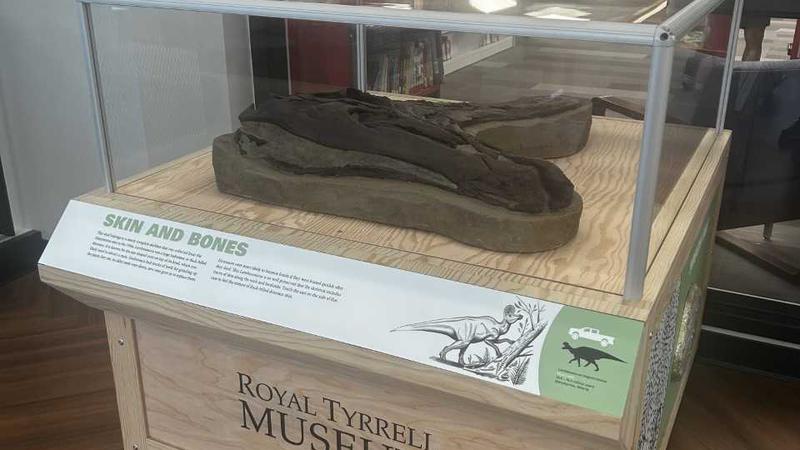
The hadrosaur Lambeosaurus fossil will be on display at the Medicine Hat Public Library for the next year. Courtesy/Medicine Hat Public Library
Palaeontology

Dino display at Medicine Hat Public Library to mark 40 years of the Royal Tyrrell Museum

Sep 24, 2025 | 8:09 AM

The Medicine Hat Public Library will be the home of a dinosaur exhibit as part of the Royal Tyrrell Museum’s 40th anniversary celebration.

Pop-up exhibits at libraries across Alberta started in September, with the Medicine Hat Public Library’s highlight fossil being the hadrosaur Lambeosaurus.

The skull cast comes from a nearly complete skeleton that was collected from the Manyberries area, about 70 kilometres south of Medicine Hat, in the 1930s.

Lambeosaurus was a large hadrosaur, or duck-billed dinosaur, and the skull is pegged at between 74.4 and 76.5 million years old.


“We are excited the Royal Tyrrell Museum is sharing a very cool piece of Alberta history with us on the occasion of its 40th anniversary,” says chief librarian Ken Feser.

“I think our visitors are going to be impressed by this cast of a duck-billed dinosaur skull that was found right here in our area,” he added.

“Parents, you definitely want to bring your kids down to the library to see this.”

In addition to the skull, the display next to the Information Desk on the upper level also includes a hadrosaur skin impression that people can touch.

The exhibit will be at the library for the next year and will be featured during school visits and other educational experiences.

The library said the children’s library staff are preparing for its traditional Dinovember to be more intense than usual, with numerous activity sheets to hand out.

The Lambeosaurus was named after the Canadian palaeontologist Lawrence Lambe, who was one of the first scientists to study Alberta’s dinosaurs.

It is known for the axe-shaped crest on top of its head, which was likely used to attract a mate.

A news release from the library said the Lambeosaurus on display is so well preserved that the skeleton includes traces of skin along the neck and forelimbs.

Hadrosaurs had stacks of teeth for grinding up the plants they ate. As older teeth wore down, new ones grew in to replace them.

Hadrosaurs were herbivores, and were nicknamed “cows of the Cretaceous’ because they were abundant, lived in herds and grazed on plants with their flatsurfaced teeth.

For more on Royal Tyrrell Museum’s 40th anniversary, visit tyrrellmuseum.com

To learn more about Medicine Hat Public Library, visit mhpl.shortgrass.ca.