SUBSCRIBE! Sign up for our daily newsletter and never miss a story!

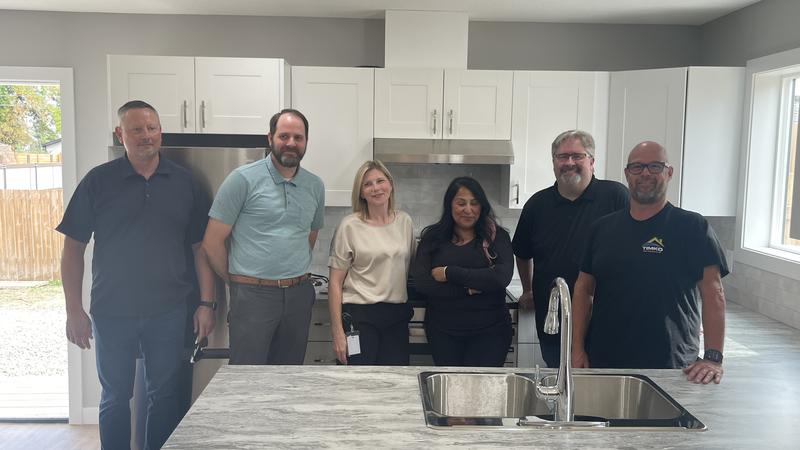
City of Medicine Hat representatives joined the builder and developer of a backyard suite in the Norwood area of the city for an open house to the media. Jesse Gill/CHAT News
HOUSING

VIDEO: City of Medicine Hat promoting backyard suites to increase infill development and help housing demand

Aug 31, 2025 | 10:34 AM

The City of Medicine Hat’s housing infill and redevelopment incentive program can offer a financial incentive for the development of a backyard suite to help diversify housing options within the city.

This is something that Gas City Ventures took advantage of at one of its rental properties in the Norwood areas of Medicine Hat.

Working with Timko Home Improvements to build a backyard suite that is just under 700 square feet, and includes a standard sized bedroom, a smaller sized bedroom, along with a full bathroom and kitchen with laundry on site.

The home is set to rent out for $1,600 a month with a tenant in place after being listed with significant interest.


The city said they offer a smart, flexible, and affordable way to add more homes in existing neighbourhoods, with typically a more simple approval process.

Craig Elder with Gas City Ventures said his group owns eight rental properties in Medicine Hat.

“We were looking at how do we continue to kind of expand our footprint doors, as they like to say, do we continue to go buy individual homes, which are getting more expensive because the demand is there,” Elder said.

“Looking at what can we realistically charge for rent, and then look at what the cost of buying those places are, and it was getting harder and harder because the banks are getting a little tighter on lending,” he added.

“As a rental property developer and owner, you have to have a certain amount down, unlike a first-time home buyer. So, it creates a little different dynamic on the finance side.”

The realization for Elder that his property had a lot with enough space in the Norwood area of the city to build a backyard suite lead to the development.

“The land is paid for, right? We’ve got tenants in this house, they don’t necessarily need the whole yard. It’s a lot for them to maintain because that’s usually the structure. You have the tenant maintain the yard, and they just need space for their dog and to have some room,” Elder said.

“So, we said this is probably the best one out of the properties we own to say, let’s add this on, and for two reasons. It’s because if and when we decide to sell it, we know it’ll be extremely attractive for a buyer, both first-time or somebody that goes, I’m downsizing, and I want to have my parents live here,” he added.

“It’s completely segregated on the utility side. A lot of backyard suites have been on the common utility, so you’re just hooking up to your house, but then if you’re putting a tenant in how do you manage that? Because if they’re leaving the lights on, and the water running, and all this other stuff, it’s not necessarily great for that landlord to have that.”

Elder said the having a self-contained basically utility in the backyard suite is a lot easier to manage.

“It also makes it a lot more attractive for that buyer down the road,” Elder said.

Director of economic development with the city Selena McLean-Moore, says infill development is important for the city to grow without having to build out its infrastructure.

“You know into the greenfield areas and so that means less cost to maintain the infrastructure over time,” McLean-Moore said.

Tim Hailwood with Timko Home Improvements said with costs and stuff like that, everything is going up constantly.

“These little houses are not super inexpensive, but again, they’re very economical for what they are,” Hailwood said.

“You can see by inside the trim, the fit finish of it is very nice. It’s not top end, it is very nicely finished too, and maintenance free wise too.”

Elder said they are kind of breaking some ground with this development.

“Tim [Hailwood] and I have been working with the city, both as the contractor and working with the sub-trades and things with the city, as far as what’s going to work and not work,” Elder said.

“The city did have some things that they wanted when it came to the splitting of the water utility, because we don’t have our own turnout for this, to make sure that who’s ever in this property is not going to be out of water if something happens on that property,” he added.

“We get that. We understand that you’re looking at it as two separate entities within one title.”

Director of planning and services with the city John Popoff said there will always be challenges when you’re trying to take new construction and incorporate it into an older neighborhood that has older infrastructure.

“There will be those issues to work through. How are we going to allocate the utilities? How are we going to place the building? How is it going to work with the existing residential adjacent to it,” Popoff said.

Elders said the city has certain requirements it needed to have.

“Like having split meters, having the upgrade to the power utility. Those are things that we’re going back and saying, if you’re going to put in a car charger for your Tesla, the city’s not going to get a ton more revenue for a $15,000 investment. They want that homeowner to pay,” Elder said.

“But we’re saying, okay, but you’re going to get a whole bunch from this. It’s different than just putting in a car charger. So work with us on maybe sharing some of that cost,” he added.

“So that’s where some of the conversation is going.”

City councillor Shila Sharps said that people always tell her that we need mini houses.

“Actually, you need a balance. You need apartments. You need little ones like this. You need big ones, because everybody has different needs and different phases of life,” Sharps said.

“But this is awesome.”

Elder said they were looking at how to densify the properties that they have.

“How do we give the spaces that people are looking for? Because you hear about the tiny house movement. People want smaller, more affordable spaces,” Elder said.

“It’s energy efficient. Radiant heating is going to be so nice to get up. And you’ve got a warm floor in the morning and a warm bathroom and everything else. Lower cost to operate. And then really it’s also saying to homeowners that are trying to get in the market, well, if you’ve got something like this, yeah, you’re going to pay up for the house, but you’ve now got a potential tenant that can offset some of those mortgage costs.”

“That cashflow helps it become more affordable, especially for a first-time home buyer. It could be a huge offset for their mortgage costs.”

McLean-Moore said in economic development, they are always looking at the workforce.

“If we don’t have enough houses, when we secure another investment, we have to make sure we’ve got enough rooms for people to live in,” McLean-Moore said.

“This is low-hanging fruit because there can be homeowners that can profit from this. So it’s the profit to the homeowners, and it’s also the opportunity for us to be able to build the houses that we need for our workforce.”

Hailwood said if you’ve got the lot size and you have enough, why not build a second residence on the same property.

“That way you can utilize each neighbor still has a ton of room and you’ve got still ample parking. You can have a place where it could be a granny suite or it can be a rental for anyone,” Hailwood said.

“The biggest thing is we have so many in these areas, we have so many large lots that you can fit two homes on and still have good size yard,” he added.

“It’s a nice rental for somebody that is looking for something that doesn’t want to be in an apartment.”

Elder said they are trying to set the standards as far as hoping others in this community are going to do the same thing.

“We want others to do this. It’s going to be better for everybody to have those choices and more inventory,” Elder said.

The city has shown a low vacancy rate for the past few years and high demand for rentals.

READ: ‘0 to 1% vacancy rate’: Medicine Hat Economic Development rejigging incentives in the face of rental challenges