SUBSCRIBE! Sign up for our daily newsletter and never miss a story!

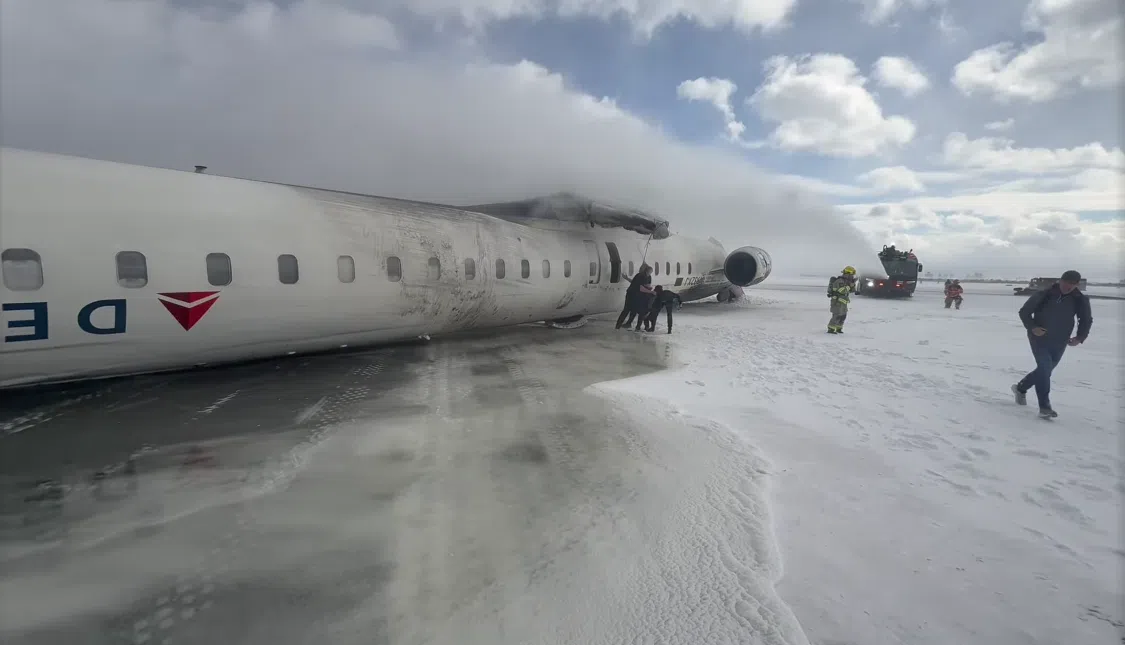
Image via John Nelson/Facebook
NATIONAL

‘Upside down and burning’: Plane crash at Pearson airport injured 19, paramedics say

Feb 17, 2025 | 6:00 PM

A critically injured child is among at least 19 passengers hurt after a Delta Air Lines plane from Minneapolis crashed and flipped over on the tarmac at Toronto’s Pearson Airport on Monday afternoon.

Ambulance service Ornge said it was transporting one pediatric patient to Toronto’s SickKids hospital and two adults with critical injuries to other hospitals in the city.

Peel Regional Paramedic Services said they had recorded 19 injuries from the crash by late Monday afternoon, adding that the plane’s 80 passengers and crew had all been accounted for.

Images and videos posted on social media showed the plane, a Mitsubishi CRJ-900LR, flipped over on the tarmac and passengers fleeing the jet as emergency crews responded to the scene.


Audio recording from the Pearson airport tower shows Delta Air Lines flight 4819 was cleared to land shortly after 2 p.m. and the tower warned the pilots of a possible air flow “bump” in the glide path from an aircraft in front of it.

There were no further conversations with the Delta flight until the tower confirmed that a plane had crashed, with air controllers quickly redirecting traffic to accommodate the crash scene.

Audio conversations from ground crews at the airport recorded a burst of commotion from workers at about the same time, with someone yelling at another person to “get off the phone,” while another crew member described “a huge emergency.”

Several minutes later, air traffic control can be heard in the recording directing a medevac helicopter for landing, and noting there are people walking around the aircraft.

“Yeah, we’ve got it,” the medevac responds. “The aircraft … is upside down and burning.”

Delta Air Lines said in a social media post that the flight was operated by its subsidiary Endeavor Air and had departed from St. Paul International Airport in Minneapolis with 76 passengers and four crew on board.

It said affected passengers’ family members and loved ones can reach out to Delta for more information.

“The hearts of the entire global Delta family are with those affected by today’s incident at Toronto-Pearson International Airport,” Delta CEO Ed Bastian said in the post.

Tracking data from FlightRadar24 shows the same aircraft flew from Cleveland to Minneapolis earlier in the day, and that it was supposed to return to Minneapolis from Toronto.

The plane had arrived at Pearson amid blowing snow following a winter storm that hit the Toronto region over the weekend.

There was no immediate word on the cause of the crash.

The Transportation Safety Board of Canada said it is deploying a team of investigators to Pearson airport and federal Transport Minister Anita Anand said she was closely following the “serious incident.”

Her U.S. counterpart, Transportation Secretary Sean Duffy, said inspectors from the Federal Aviation Administration were on their way to Toronto and the Canadian investigators would take the lead.

“I’ve been in touch with my counterpart in Canada to offer assistance and help with the investigation,” he said on social media.

Ontario Premier Doug Ford said in a social media post that provincial officials are in contact with the airport and local authorities and will provide help as needed.

After the crash, flights in and out of Pearson airport were temporarily suspended.

A spokesman for Montreal-Trudeau International Airport said it was preparing to receive aircraft originally bound for Toronto.

Eric Forest, a spokesman for airport authority, said several diverted flights were expected in Montreal following the accident.

“Our teams are in action to welcome them,” Forest said in an emailed statement.

At Pearson, confused passengers gathered at terminals amid mixed messaging from airport and airline staff.

At one point, an overhead announcement told everyone to proceed to the exit and baggage claim, but some workers were telling passengers to remain at their gates.

Departures and arrivals resumed as of 5 p.m., and airlines suggested passengers check the status of their flights.

Porter Airlines said on social media just before 5:20 p.m. that operations were “in the process of recovering.”

— With files from Sonja Puzic in Toronto, Sidhartha Banerjee in Montreal and Chuck Chiang in Vancouver.


A video appears to show a passenger hanging upside down in a plane.

The Bombardier CRJ-900 involved in the crash was a Delta flight that had departed from Minneapolis, according to data from FlightRader24.

A winter weather travel advisory was in place for the Toronto area on Monday.

Toronto Pearson said Monday morning that airlines were catching up after a weekend storm that dumped 22 centimetres of snow at the airport.

It added it was expecting over 130,000 passengers for about 1,000 flights.

Rare to be upside down

An aviation expert with more than 30,000 flight hours says it is “very rare” for an aircraft to end up upside down in a crash, as was the case with a Delta Air Lines plane that flipped on the tarmac at Toronto’s Pearson Airport Monday.

J. Joseph, a 29-year veteran aviator in the United States Marine Corp., says it is much too early in the investigation to jump to conclusions about what happened, but conditions in Toronto were “quite windy” at the time of the crash.

Joseph says high winds, especially crosswinds that blow perpendicular to the plane, could “present certain challenges to pilots” as they try to navigate the landing at Pearson Airport.

The flight from Minneapolis crashed Monday, intact but upside down, with the wheels of the Mitsubishi CRJ-900LR jutting into the air on the snow-covered tarmac.

Several of the 76 passengers and four crew members were injured.

In an audio conversation between the airport tower and the Delta flight shortly before landing, the tower warned the pilots of a possible air flow “bump” in the plane’s landing glide path stemming from an aircraft in front of it.

But Joseph says it is unlikely that was a factor in the crash, given that air-traffic control is exceptionally skilled at planning adequate space between planes to prevent too much impact from wake turbulence, adding that the strong winds would present a bigger risk.

“Toronto in the winter with high, gusty winds, it could be very challenging,” he says. “Those high winds and with regard to runway alignment, perhaps crosswind components in winds extremely strong from the left of the right of the aircraft, present certain challenges to the pilots.

“I’ve got 30,000 hours of flying airplanes. It never gets easy. I don’t care how much experience you have. Every set of circumstances is different, and the conditions change very dynamically.”

But Joseph says how the plane ended upside down will still need to be explained.

“For an aircraft, particularly a large transport-category airplane, to end up in under those circumstances — upside down — is rather rare,” he says. “It has happened in the past, but I will tell you candidly, it is very rare.”

Joseph also says the fuselage being preserved in the crash bodes well for the investigation, as the plane’s “black box” cockpit voice recorder and flight data recorder will both likely be intact.

“There are going to be a lot of good data, real time, extracted from the data recorders, as well as the pilots and the flight crew being able to give statements,” he says.

“You learn a lot from mishaps and the investigation. The crux of why you do it in the first place is to preclude those types of mishaps from reoccurring.”