SUBSCRIBE! Sign up for our daily newsletter and never miss a story!

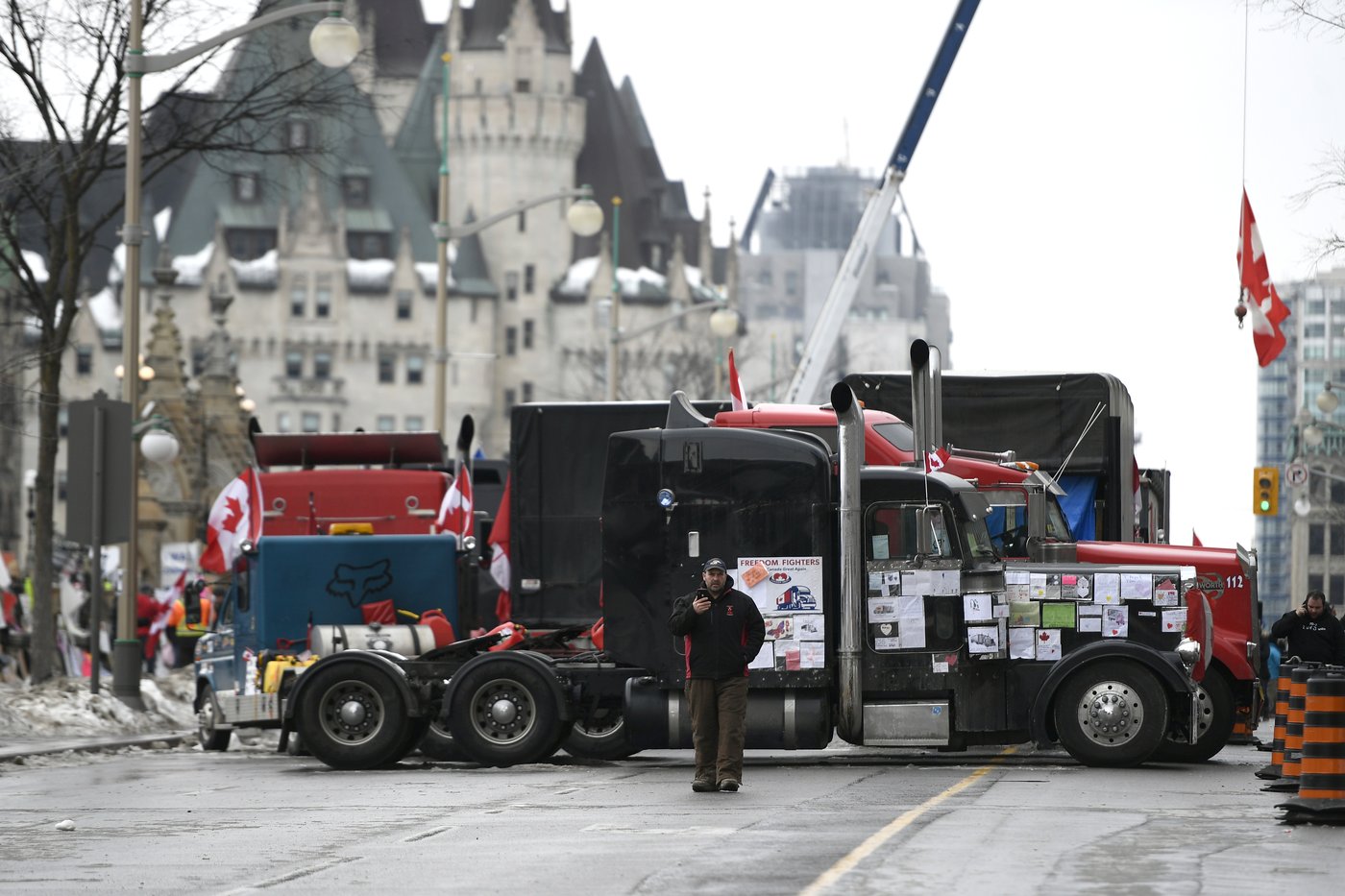
Trucks are seen in front of the Chateau Laurier hotel as a protest marked by gridlock and blaring horns reached its 14th day in Ottawa on Thursday, Feb. 10, 2022. THE CANADIAN PRESS/Justin Tang

Lower courts’ reasoning ‘neuters’ Emergencies Act, government tells Supreme Court

Oct 22, 2026 | 2:00 AM

OTTAWA — The federal government says the courts engaged in “second-guessing with the benefit of 20/20 hindsight” when they ruled it lacked legal justification to use the Emergencies Act four years ago to quell protests.

Lawyers for the government make the argument in a submission seeking a Supreme Court of Canada hearing of the federal case for invoking the emergencies law to deal with protest actions in the national capital and at key border points.

The top court is slated to rule Thursday on whether to grant the government leave to appeal.

For about three weeks in January and February 2022, downtown Ottawa was filled with protesters, including many in large trucks that blocked streets around Parliament Hill.

While many protesters demonstrated against COVID-19 health restrictions, the “Freedom Convoy” protests also attracted some with a variety of grievances against then-prime minister Justin Trudeau and his government.

Trucks also jammed key border crossings to the United States, including routes at Windsor, Ont., and Coutts, Alta.

On Feb. 14, 2022, the government invoked the Emergencies Act, which allowed for temporary measures, including regulation and prohibition of public assemblies, the designation of secure places, direction to banks to freeze assets, and a ban on support for protest participants.

It was the first time the law had been used since it replaced the War Measures Act in 1988.

In a Feb. 15 letter to premiers, Trudeau said the federal government believed it had reached a point “where there is a national emergency arising from threats to Canada’s security.”

The Public Order Emergency Commission, which carried out a mandatory review after the act was used, concluded in early 2023 that the federal government had met the very high legal standard for using the law.

The Trudeau government’s move was also scrutinized in Federal Court.

The Canadian Civil Liberties Association and several other groups and individuals argued that Ottawa lacked sound statutory grounds to deploy the emergency measures.

The government said the steps taken to deal with the turmoil were targeted, proportional and time-limited, and complied with the Charter of Rights and Freedoms.

Richard Mosley, the Federal Court judge who heard the case, concluded the decision to invoke the Emergencies Act did not bear the hallmarks of reasonableness — justification, transparency and intelligibility — and was not supported in relation to the relevant factual and legal constraints.

Ultimately, there “was no national emergency justifying the invocation of the Emergencies Act,” Mosley said in his January 2024 ruling.

In January of this year, a three-judge panel of the Federal Court of Appeal unanimously affirmed that ruling.

The Court of Appeal said that as disturbing and disruptive as the blockades and the “Freedom Convoy” protests in Ottawa could be, “they fell well short of a threat to national security.”

In its written submission requesting a Supreme Court hearing, the government says the Federal Court and the Court of Appeal “applied the wrong principles on judicial review.”

The courts should have asked whether — based on the information available at the time — federal officials acted reasonably in concluding a public order emergency existed, the submission says.

“Instead, they asked, with the benefit of hindsight, whether there were reasonable grounds to believe that a public order emergency existed.”

In the end, both courts applied their own view of what was reasonable, the government says.

“This non-deferential approach hamstrings governments’ ability to respond effectively to future crises, neuters the Act” and conflicts with the Supreme Court’s administrative law rulings over the years, the submission says.

“It amounts to second-guessing with the benefit of 20/20 hindsight,” the government adds.

“In the end, no one disputes that emergency measures should be a temporary means of last resort. But that does not mean those measures should be available only in the most dire and extreme circumstances.”

In its submission to the Supreme Court, the Canadian Civil Liberties Association says the government should be denied leave to appeal because it is attempting to relitigate “the same issues and arguments the Court of Appeal dismissed.”

This report by The Canadian Press was first published Oct. 22, 2026.

Jim Bronskill, The Canadian Press