SUBSCRIBE! Sign up for our daily newsletter and never miss a story!

Medicine Hat city council listens during a public hearing on a proposed municipally-controlled corporation on June 24, 2025. Eli J. Ridder/CHAT News
CITY HALL

Medicine Hat council should leave energy business revamp vote until after election, residents say

Jun 24, 2025 | 11:30 PM

Several residents called on Medicine Hat’s elected representatives to defer a vote on spinning off its energy business into an arms-length corporation until after the next civic election.


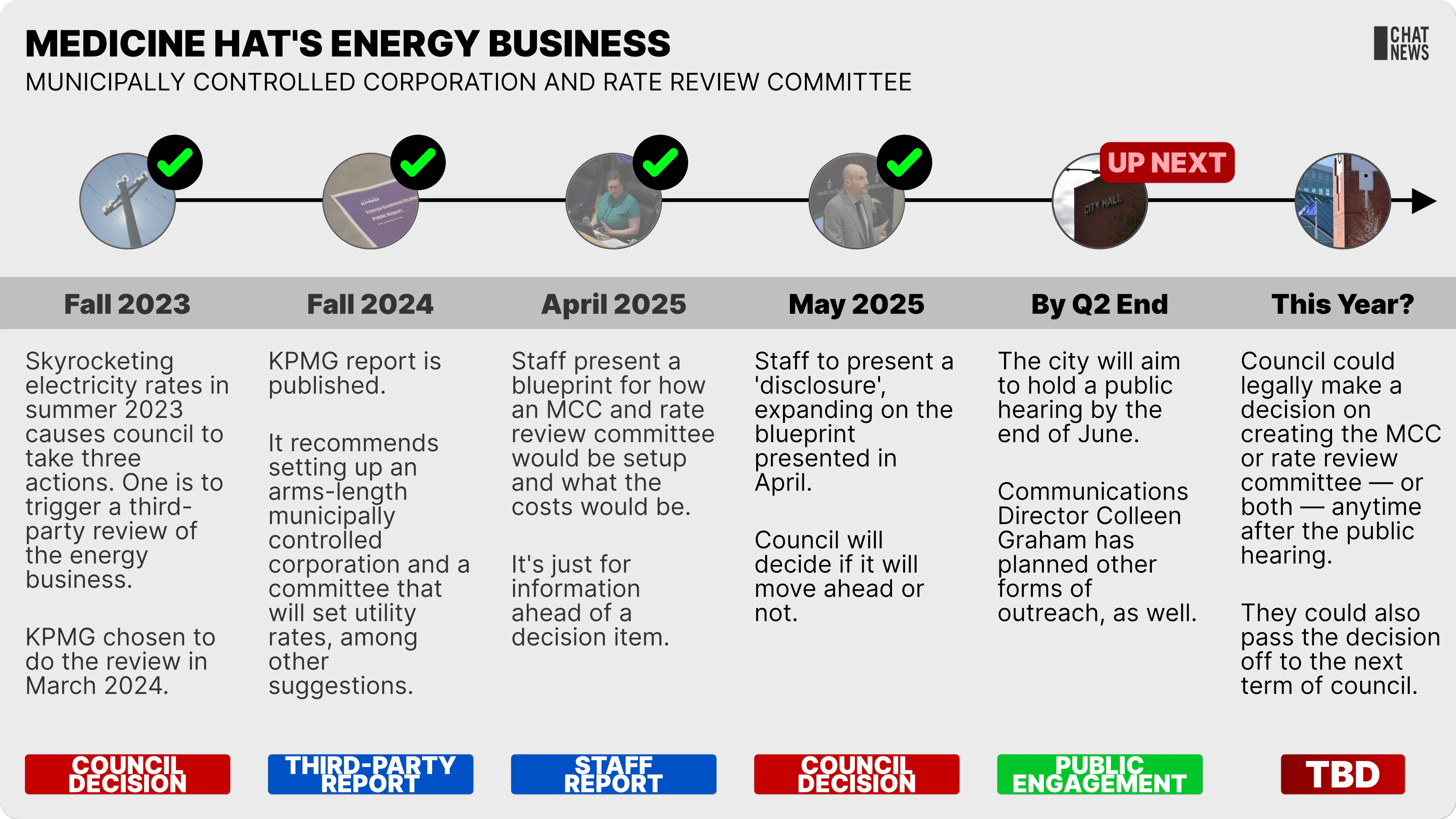
After residents spoke for and against the plan during a public hearing Tuesday, council voted 8-1 to pause, take in public comments and pick up deliberations again on July 21.

Coun. Robert Dumanowski voted against the deferral but did not speak to reporters about his decision following the meeting.

Resident Scott Payne, one of those speaking against the proposal, said he agreed with Mayor Linnsie Clark’s call earlier this year for council to pass on the decision to the next term of elected representatives.

“I agree with her on that, this is the end of your term, your mandate — and none of you ran on it,” he told council.

Payne argued that perceived council infighting over the term disqualifies it from voting.

“This council I don’t think is qualified to do this,” he added.

“If people are not getting along and can’t talk and can’t have meetings, then should they be making a major decision like this?”

Many of the other residents who spoke against spinning off the energy business that Medicine Hat has owned for nearly 125 years agreed this term of council shouldn’t make the final decision.

Energy head Rochelle Pancoast kicked the hearing off with a presentation outlining the background and the decision that council faces.

A third-party review by KPMG suggested the creation of a municipally controlled corporation — among three other proposals.

At hand was the recommendation — backed by Rochelle and her staff — to create a corporation that will still ultimately answer to the city.

It would be run by a board of experts and pay dividends to Medicine Hat, lifting day-to-day operational responsibility away from council.

Also recommended is KPMG’s second proposal to establish a rate review committee that would determine what shows up on the bills of electricity and natural gas ratepayers.

Coun. Shila Sharps said she understood residents who asked the current council to pass on making the final call on the energy business changes.

“We’ve lost the trust of the public to make some of these key decisions and that falls on us,” Sharps told CHAT News following the public hearing.

“They just want a council that’s prepared to make the hard decisions and have the hard conversations — and they’re right, that’s exactly what they should expect,” she added.

“But when you keep deferring conversations that are difficult, why would you trust us to make this?”

One of the other takeaways for Sharps was that some residents didn’t have all the information — or had misinformation.

“That tells me that we still need to get information out there,” added Sharps.

The City of Medicine Hat held two public information sessions earlier this month ahead of the hearing and have a Shape Your City page dedicated to informing residents.

At least one resident at the public hearing suggested the city could do more, including letting people know about the proposal through the mail or on utility bills.

‘Something worth trying’

Three residents spoke in favour of a municipally controlled corporation during the hearing Tuesday.

Kris Samraj, who served on council from 2017 to 2021, said he supports the corporation because of how it splits up the political responsibility of advocating for affordable utility rates while handing off operations to the energy organization.

“The political question that council is balancing is what is the benefit of a public utility, a dividend to the city or affordable electricity rates, or a balance between the two,” Samraj said.

He said the municipally-controlled corporation could help that inevitable tug of war.

“We all agree that we want a stable, sustainable public utility. Having an MCC is the best way to accomplish that,” Samraj said.

“There will always be tweaks this council and future councils can make to fine tune the MCC model, the rate review committee and the dividend policy.”

His question triggered some deliberation around the horseshoe about the responsibilities council would have with such a set up.

Council and the corporation would sign a unanimous shareholder agreement that would empower the corporation to make decisions but also provide metrics to accomplish, legal officials said.

Solicitor Matthew Klassen told council it would decide how much independence it would give the corporation and when a decision would rise to the level it would come to council.

That level of control could shift over time, Klassen told Coun. Andy McGrogan.

“The parameters could be adjusted from time to time — although the bulk of the work would be done at the outset,” Klassen said.

‘Famously dysfunctional’

Craig Ruttan, an accountant, said spinning off the energy business provides council an opportunity to pass on responsibility.

“It provides political cover for unpopular or difficult decisions that councillors may not wish to make,” Ruttan argued.

“I would recommend to any councillors that do not wish to make unpopular or difficult decisions to not stand for election.”

Ruttan, echoing several others, also called on council to wait on a vote.

“Instead of making a decision now with a publicly and, quite honestly, famously dysfunctional council to postpone that decision until after the election,” he said.

Ruttan echoed some critics of the restructure when he argued any increase in expertise the new organization could bring would be offset by decreased public accountability.

“There’s no need to do this,” Ruttan said as he finished addressing council.

“Separating out a beloved public utility will be a deeply unpopular decision for everyone involved here.”

What’s proposed?

Municipally-controlled corporations are found in several municipalities across Alberta, including in Edmonton, St. Albert and others.

Red Deer is currently going through the process to establish an MCC, according to a staff report.

Launching an MCC could cost a one-time $4 to $5 million fee to set up, staff report.

Ongoing operating costs for the board, new positions, systems and additional allowance for further transition could cost $2 to $3 million annually, working out to one to two per cent of the city’s annual operating costs.

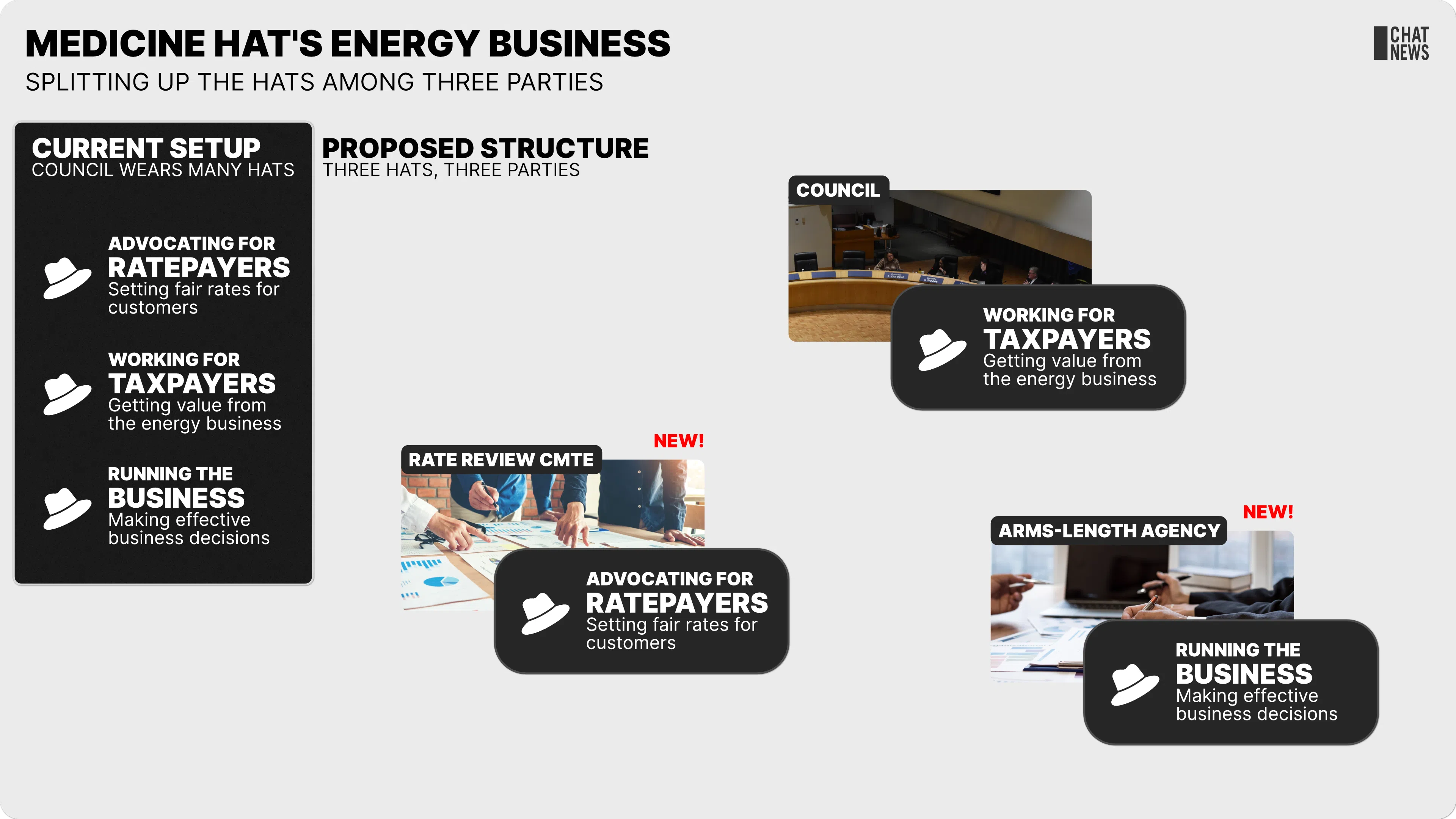
Pancoast, the city’s energy, environment and land division head, said in April that council plays three different roles.

Pancoast says that council wears different hats: one to represent the ratepayer, one to represent the energy business as a business and one to represent the taxpayer.

The municipally controlled corporation and the rate review committee aims to solve the multi-hat problem by each taking on a role — but without taking away the city’s ultimate authority.