SUBSCRIBE! Sign up for our daily newsletter and never miss a story!

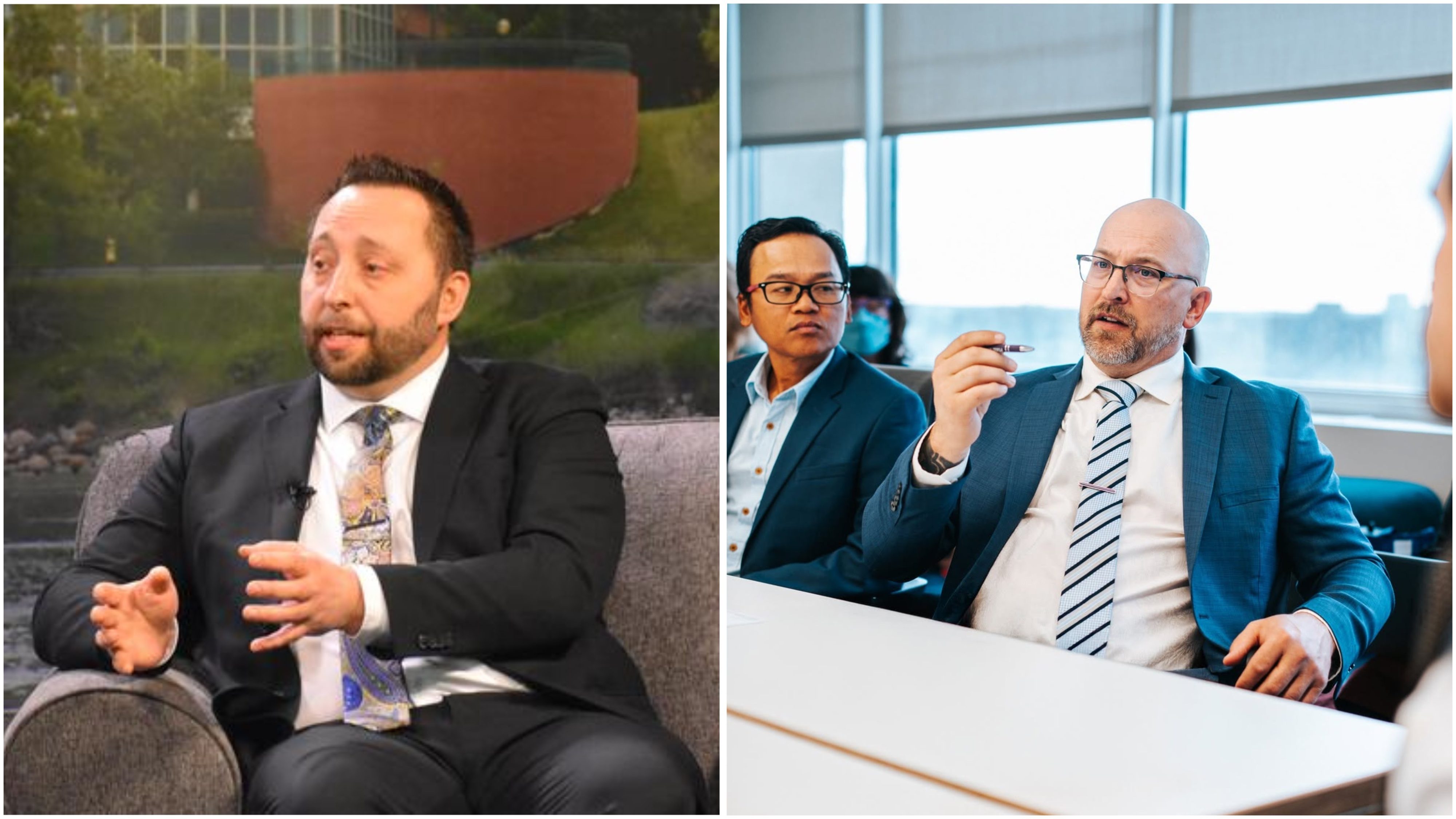
Left: CHAT News stock photo of Cypress-Medicine Hat MLA/Alberta Minister of Primary and Preventative Health Services Justin Wright. Right: Cypress County Deputy Mayor Robin Kurpjuweit at the Federation of Canadian Municipalities serving as chair of the Rural Forum. (Image Credit: File Photo/CHAT News; Federation of Canadian Municipalities)
South Korea and Japan

Alberta health minister studies Asian health-care models; Cypress County explores Japan market

Oct 27, 2026 | 1:34 PM

Alberta health minister has been looking to Japan and South Korea for ways to improve preventative health care and cancer detection, while a separate Cypress County trip to Japan is exploring export and investment opportunities for southeastern Alberta.

Cypress-Medicine Hat MLA and Alberta’s Minister of Primary and Preventative Health Services Justin Wright travelled to Japan and South Korea from Sept. 4 to 13 to study their primary health-care systems, including preventative screening, patient attachment and access to physicians.

Wright said one of the biggest takeaways was how the countries approach early detection and organize their health-care services.

“When I look at Alberta, we spend in the realm of about $8,000 per patient per year in primary health services. And they’re spending in the range of about $3,500,” Wright said.

“They have a much larger population, very similar services. It was really [about] understanding where perhaps some of our pain points were in comparison to where they got.”

Wright said he was particularly interested in South Korea’s approach to primary care and Japan’s preventative health-testing model, known as Ningen Dock.

During the trip, Wright experienced a preventative health test through an organization called Korea Medical Institute (KMI), paying to undergo the testing himself to better understand how the system operates.

The basic assessment included more than 15 tests, including X-rays, ultrasounds, blood work and examinations of the eyes and ears.

“We had all of these tests that would normally take six to eight months here in Canada. We were able to get these tests done in a little over an hour and a half,” Wright said.

He said the visit allowed him to examine not only the range of tests offered, but also how the clinics organize their services to complete them efficiently.

Wright also pointed to cancer outcomes as a reason for examining the systems more closely.

He said cancer survivability rates in the model he discussed increased from 60 per cent to more than 88 per cent, crediting regular screening and early detection as key factors.

“And it really boils down to regular and early detection,” Wright said.

“So their number of stage 3 and stage 4 cancers have dropped exponentially. They have seen an increase in stage 1 and 2, which is the game plan of what the system is designed to do. They want to catch it early and often.”

Wright said Alberta is already evaluating how elements of the approach could be adapted for the province.

“It was one of those things that we’re already evaluating. How do we bring that system back over here? And how we can really set something similar up,” he said.

Wright added that KMI had expressed interest in coming to Alberta, leaving the door open to further discussions about bringing similar services to the province.

“The door’s open, and we’d love to see these types of systems come on over,” Wright said.

South Korea also offered lessons in how patients connect with primary care.

Rather than attaching patients to an individual physician, Wright said the Korean model connects residents to a community health centre based on where they live.

Physicians continue to provide care and maintain patients’ medical histories, but the attachment is to the centre rather than a specific doctor.

“They actually have 100% patient attachment, and they’re able to get into their physicians within 48 hours,” Wright said.

Wright said he would spend more time in South Korea if given the opportunity to repeat the trip, pointing to the country’s approach to improving outcomes and reducing treatment delays.

“The Korean model was distinctly different from ours, and it gave us a real [lesson] to follow the data,” Wright said.

“This is true, proven data over a span of 30 years, where the outcomes [that] started in a system very similar to ours, where they’re at now: better patient outcomes, better treatment turnaround times, and better delivery of medicine.”

He said Alberta is examining both preventative screening and patient-attachment models to identify changes that could improve access without unnecessarily disrupting existing services.

“We are taking a look at their attachment models and how they get patients in front of physicians and nurse practitioners and primary care practitioners to be able to find real, meaningful changes that are not disruptive, that are going to lead to better outcomes,” Wright said.

While Wright’s trip focused on health care, Cypress County Deputy Mayor Robin Kurpjuweit travelled to Japan from Oct. 9 to 18 to begin building relationships and explore opportunities for regional businesses.

Kurpjuweit said the trip was an information-gathering mission intended to help the county understand the Japanese market and identify potential partners for future investment and exports.

Cypress County Council had sent two other elected officials on separate information-gathering missions, with Councillor Michelle McKenzie to attend PACK EXPO in Chicago, and Mayor Dan Hamilton was scheduled to travel to Frankfurt.

“Japan is a difficult market to get into. It’s a relationship-based market, and so nobody’s going to get into Japan and just come home with a deal,” Kurpjuweit said.

The delegation met with representatives from the Canadian embassy, trade commissioners, Invest Alberta and the Alberta business office in Japan.

Kurpjuweit said the initial goal was to listen, learn about the market and begin establishing connections that could lead to more targeted business discussions.

“We tried to listen more than we spoke because we had a lot to take away from that,” Kurpjuweit said.

“But as you’re having conversations and building that rapport and that relationship, you’re sharing information about the county and who we are and such.”

Kurpjuweit said the county sees potential to help southeastern Alberta businesses expand into overseas markets, particularly in agriculture and food processing.

He pointed to Japan’s demand for imported food and the scale of its consumer market as potential opportunities for regional producers.

Kurpjuweit said conversations at a food ingredients show highlighted demand for products containing additional fibre, an area where crops grown in southeastern Alberta could have potential applications.

“We have a lot of agriculture, we have a lot of growing space and land, and so that’s an automatic right there,” Kurpjuweit said.

He also pointed to existing Japanese-owned businesses in the region, including Cancarb, as an example of established connections between Japan and southeastern Alberta.

Kurpjuweit said the county may want to identify local businesses interested in expanding their operations, exporting finished products or attracting overseas investment.

One possibility is helping producers move beyond selling raw agricultural products by processing and packaging goods locally for international markets.

“It’s very difficult to scale out. We can’t gain more land, but we can definitely do more with what we grow on our land,” Kurpjuweit said.

Kurpjuweit also sees potential in Japan’s retail market, including its extensive network of convenience stores.

He said understanding how products reach consumers in Japan could help regional businesses consider different ways of entering the market, rather than relying solely on large retail chains.

“If you can get your product into a 7-Eleven in Japan, and when we’re talking about health food products, and fibre-loading, those different supplies or products, seeing how we can take what we grow and then what that end product can look like packaged is huge,” Kurpjuweit said.

The county’s next steps will be debriefing following these trips and possibly identifying businesses with an interest in pursuing some of these opportunities.

Kurpjuweit said another trip could take place in the future depending on the progress made through follow-up work and the identification of suitable partners.

He also pointed to the potential for collaboration with Hokkaido, a Japanese region with an established relationship with Alberta, particularly in aerospace and air defence.

“We’re not happy with just staying status quo. We want to be leaders, and we want to thrive as a region,” Kurpjuweit said.

He said the county’s ability to be flexible and move projects forward could be an advantage when working with prospective investors.

“Within the county, we’re fortunate. We’re a fairly small business unit that can be fairly flexible and adaptable, and we’re nimble,” Kurpjuweit said.

“For people that want to come in and start things, and where speed and getting shovels in the ground matters, we [can] really provide them with an advantage there.”

Kurpjuweit said the Japan trip was a starting point rather than a finished deal, with future progress depending on the relationships developed and the businesses that can be connected with potential overseas markets.

The goal, Kurpjuweit said, is to turn the information gathered into practical opportunities for producers and businesses across southeastern Alberta.

“We’re proud of where we are, and we’re proud of that, and we tried to bring that to the table there,” Kurpjuweit said.