SUBSCRIBE! Sign up for our daily newsletter and never miss a story!

(Image Credit: Martinmark/Dreamstime)
Price at the pump

Petroleum Analyst expects gas prices to remain up in Medicine Hat

Mar 11, 2026 | 1:47 PM

The war in the Middle East has driven up oil prices globally, a trend that could continue with market volatility increasing prices at the gas pump.

Matt McClain, a petroleum analyst with GasBuddy, says the uncertainty around shipping through the Strait of Hormuz is a key factor driving markets.

“For right now, all eyes are on that Strait and whether or not things are going to be resolved,” McClain said.

Even after coordinated releases from strategic oil reserves announced Wednesday morning, benchmark prices are expected to continue climbing.

“I’m looking at Brent crude, West Texas intermediate crude, even after the announcement of a controlled or an organized release from multiple strategic oil reserves across the globe, oil prices are still shooting up some five per cent at this point, and that is no surprise to me at all,” McClain said on Wednesday morning.

McClain says increases in crude oil can show up at the pump within days.

“Over the past week, across Canada and beyond, we see exactly how quickly prices at the local pump can be impacted as a direct result of crude oil prices rising,” McClain said.

“We have continued to see that, I think we will continue to see that going forward with prices expected to continue increasing, albeit hopefully at a slightly slower pace than we’ve seen over the past week.”

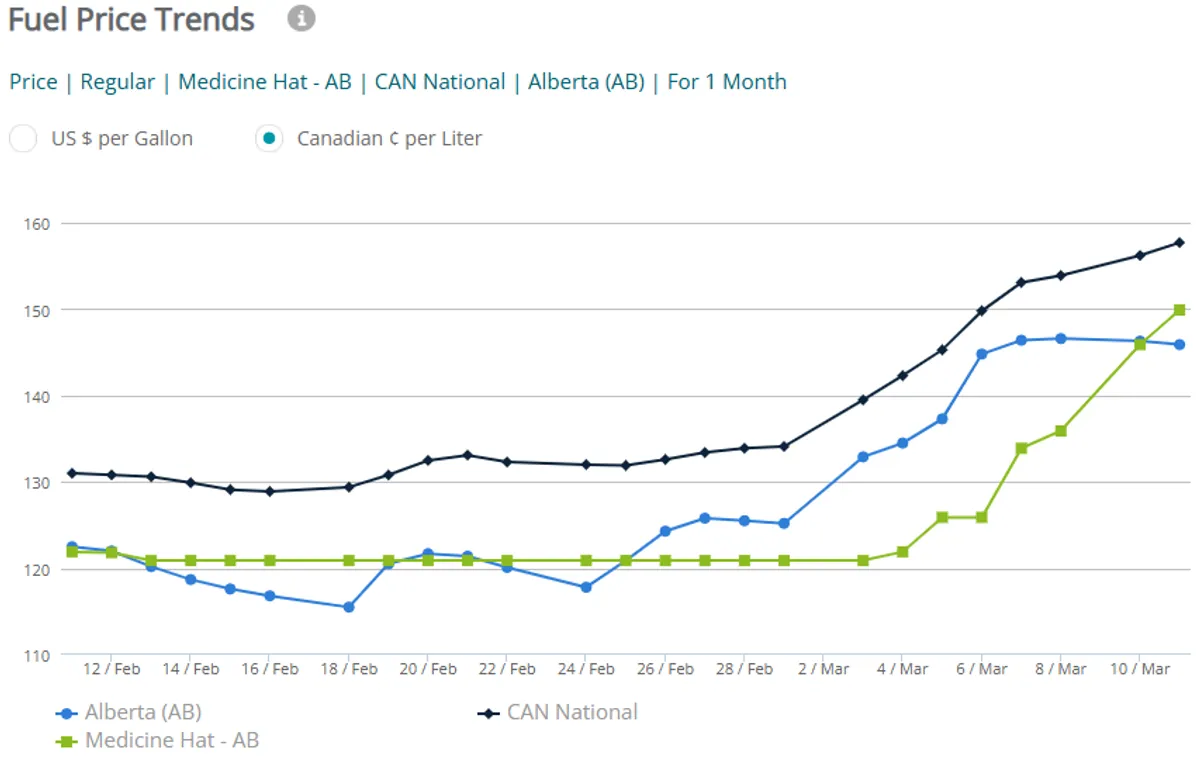
Communities like Medicine Hat have already seen sharp jumps, with prices rising roughly 28 cents per litre in a week.

Medicine Hat's monthly price change in gas.
Medicine Hat’s monthly price change in gas. (Image Credit: Screenshot: GasBuddy.com)

GasBuddy shows that prices in Medicine Hat held at an average of 120.9 cents per litre from Feb. 13 until Mar. 3, with an initial jump to 121.9 on Mar. 4, eventually landing at the 149.9 average on Mar. 11.

On Wednesday, Medicine Hat sits below the national average of 157.7, but above the provincial average of 146.1.

Price jumps are common around this time of the year, with the switch over from a winter blend to a summer blend of gasoline at the pumps.

“We normally see an increase in prices going from now through roughly the end of May. That’s typical every single year because reformulated gasoline is more expensive to produce than the winter blend,” McClain said.

“We won’t really go back to the price point of where we were a couple of weeks ago, simply because of those dynamic shifts in change if we can come up with a solution to the conflict overall, but we will certainly fall, no question, and get back to a sense of what I would consider to be normalcy.”

He also warns that higher diesel costs could ripple through the economy, potentially increasing prices for groceries and other goods if shipping costs continue to climb.

“If we continue to see an elevated price in diesel, I’m starting to become even more concerned about the commodities aspect, especially where the litmus test would basically be in the more perishable items in a grocery store,” McClain said.

“That is where you would basically start seeing the increase first. We’re talking about things like fresh produce, never frozen meats, dairy products, things that require more frequent shipments because their shelf life is less than that of a canned good or a shelf-stable boxed item,” he added.

“If we keep elevated price points, we are probably going to see some spillover that consumers are going to have to start absorbing on top of the higher price point that we’re seeing at the local gas station.”

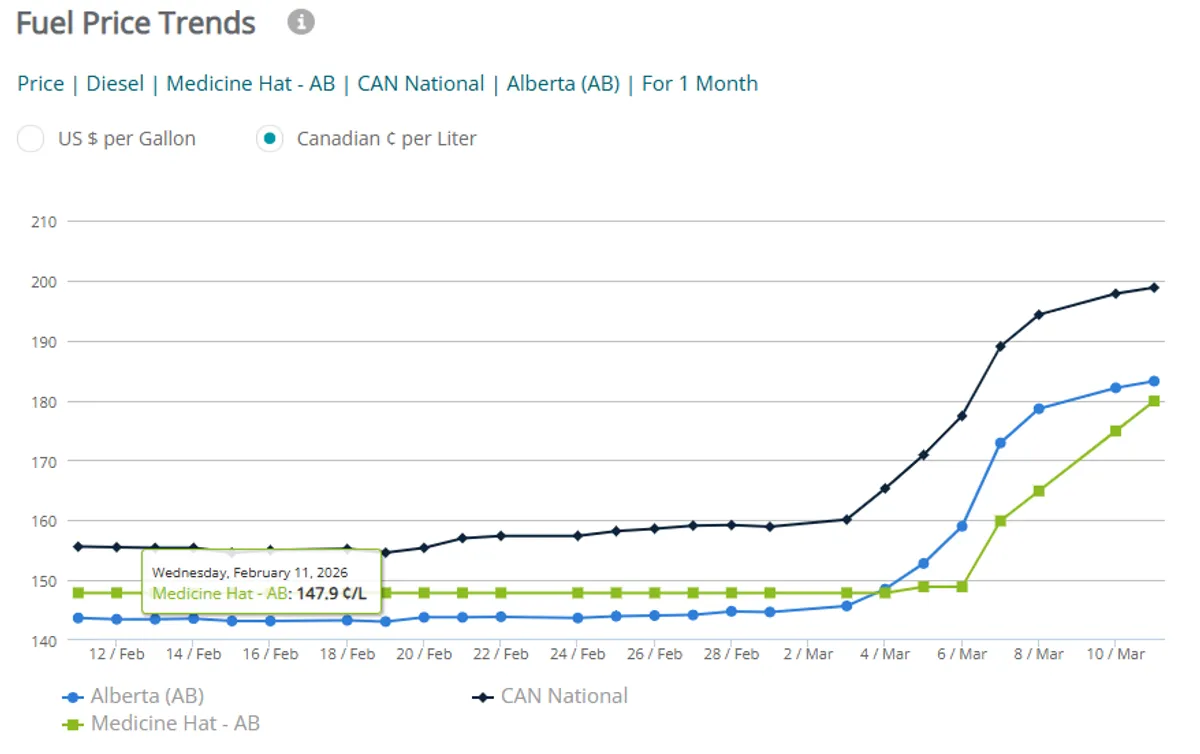
Diesel prices have jumped 32 cents per litre in Medicine Hat since early March.

Medicine Hat's monthly price change in diesel.
Medicine Hat’s monthly price change in diesel. (Image Credit: Screenshot: GasBuddy.com)

On Wednesday, they sit at an average of 179.9 cents per litre in Medicine Hat, up from 147.9 a week prior. Still lower than the national average of 198.8 cents per litre and the Alberta average of 183.2.

The Alberta provincial budget was released in late February, and the projected $9.4 billion deficit is based on the West Texas Intermediate price being $60.50 US per barrel. By early Wednesday afternoon, it was trading at $87.53 US per barrel.

“In the context of government funds, as well as anyone attached to the oil industry, there could be some positive upside with regard to financial gain,” McClain said.

“Unfortunately, if you’re not tied to the oil industry in any way, it doesn’t necessarily equate to a better situation,” he added.

“You want your oil companies to be financially viable and successful. We definitely want that profit to be there, no question whatsoever.

Just trying to find that balance, however, is a little bit of an ordeal.”

He adds that high prices can lead to a reduction in fuel usage across the general population, thereby washing out the potential increase in gains.

When comparing gas prices to a year ago, they are approximately 18 cents per litre lower than they would be if a carbon tax were still in place.

The Canadian government removed the consumer carbon tax on gas, diesel, and other heating fuels on April 1, 2025.