SUBSCRIBE! Sign up for our daily newsletter and never miss a story!

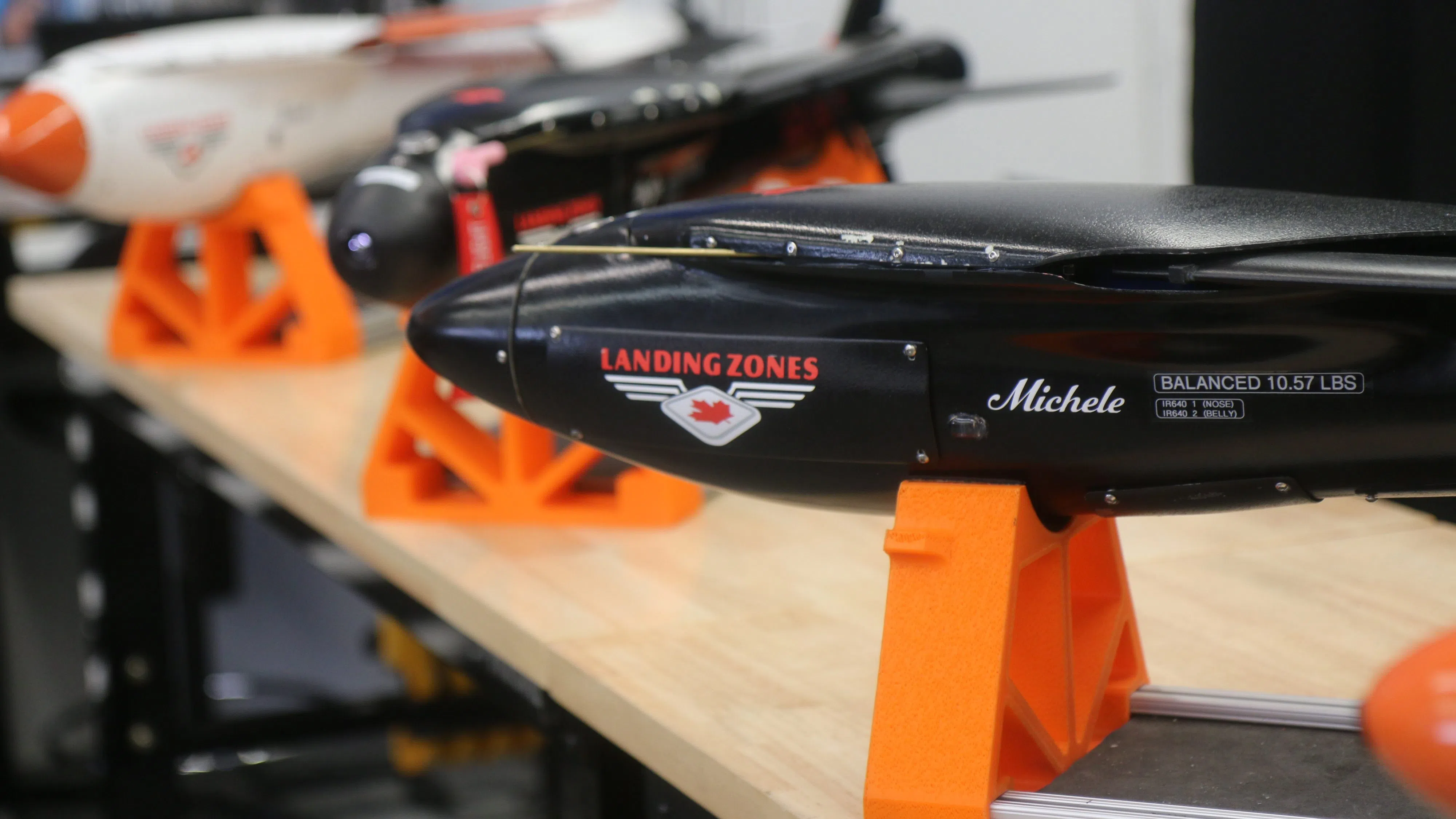
A drone is on display at Landing Zones Canada during a federal funding announcement at the Medicine Hat business on March 2, 2026. (Image Credit: Jesse Gill/CHAT News)
Artificial Intelligence Drones

Medicine Hat’s Landing Zones Canada receives $1.1 million government loan to develop AI technology

Mar 2, 2026 | 9:44 PM

The Federal Minister of Emergency Management and Community Resilience, Eleanor Olszewski, was in Medicine Hat on Monday for a major funding announcement for Landing Zones Canada.

A $1.1 million repayable grant was announced to support a Medicine Hat-based company through the Regional Artificial Intelligence Initiative (RAII), part of Prairies Economic Development Canada (PrairiesCan).

It will allow the Medicine Hat business to develop, deploy and commercialize new artificial intelligence technologies that have the potential to revolutionize atmospheric weather sampling, while supporting defence applications.

The funding will help Landing Zones Canada enhance the capabilities of its innovative GITPO Remotely Piloted Aircraft System product.

The device is engineered for high-altitude use and uses artificial intelligence to return to base, addressing the environmental and operational inefficiencies of single-use weather balloons.


Press Conference Highlights March 2, 2026

READ: Medicine Hat company aims to solve weather balloon waste with reusable drones (Aug. 22, 2024)

The federal minister said that AI is creating a revolution worldwide.

“Alberta businesses are not just keeping up – they’re leading the way in innovation and the development of dual-use technologies that solve real-world challenges and strengthen Canada’s sovereignty,” Olszewski said.

“Our new government continues to invest in businesses harnessing AI to bring new, more sustainable solutions to market,” she added.

“Today’s investment in Landing Zones Canada is a clear example of a forward-looking investment, creating good jobs and positioning Canada for continued AI and defence leadership.”

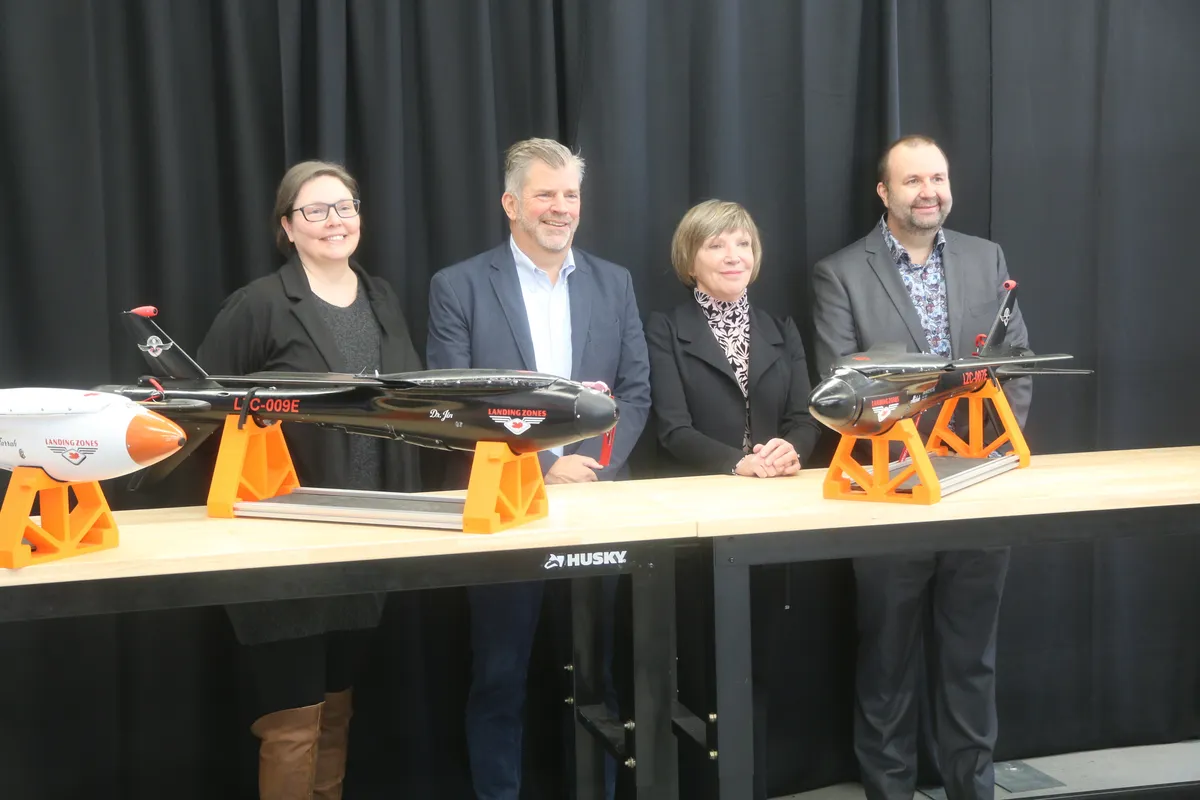
From Left to Right, Medicine Hat Mayor Linnsie Clark, Landing Zones Canada Founder and CEO Spencer Fraser,  Federal Minister of Emergency Management and Community Resilience Eleanor Olszewski, and Community Futures Entre-Corpe General Manager Sean Blewett.
From Left to Right, Medicine Hat Mayor Linnsie Clark, Landing Zones Canada Founder and CEO Spencer Fraser, Federal Minister of Emergency Management and Community Resilience Eleanor Olszewski, and Community Futures Entre-Corpe General Manager Sean Blewett. (Image Credit: Jesse Gill/CHAT News)

Landing Zones Canada Founder and CEO Spencer Fraser said he is extremely thankful to the Government of Canada for its leadership in supporting innovative AI solutions.

“Few Canadians know that current radiosondes and ozone sondes are single-use devices, with over 600,000 launched annually worldwide, and in Canada, they litter 24 per cent of our vast landmass, creating the world’s largest source of e-waste from meteorological monitoring,” Fraser said.

“Our reusable GITPO drone provides a sustainable alternative, and this RAII funding will greatly accelerate our ability to deploy this solution here in Canada and for export.”

Fraser said the drone uses pre-surveyed collection points.

“The drone will say, you know what, can’t make it back to your seat, I’m going to go to that seat and land,” Fraser said.

“Then working with First Nations partners, we can then send out teams to go collect the stuff and reuse them,” he added.

“We think we can reuse the drones several hundred times before they have to be replaced.”

There is also an opportunity on the military side with the drones, as they can reach heights of up to 100,000 feet.

“We’re routinely flying above 60,000 feet. Now the cool part is we get the same IFF code as the U2. What Canada is facing now and what we see, unfortunately, being used in Ukraine are weapon systems that go and obviously try to exploit altitude so that you can’t breach them,” Fraser said.

“Canada is investing over $30 billion in NORAD modernization, but $6 billion dollars alone on over-the-horizon radars. The only way you can test that is by putting something in situ and measuring it,” he added.

“You can simulate everything, but at the end of the day, you’ve got to get up there and say it doesn’t work. So that’s how we started with the military side of the house.”

With the success, Fraser said that they have international interest in their product.

“We have NASA coming to town. They want to use our kit. We’ve got the Japanese who are coming. They want to fly in the Arctic with us. We’ve got the French. We’ve got the Germans,” Fraser said.

“It’s really taken off, and we’re not following anyone. We’re carving out a new area, and it’s pretty humbling to say that we’re the best in the world at what we do,” he added.

“Just before Christmas, I said that in Ottawa. I was asked if I was American because I was too brazen. I had to say no, I’m from Alberta. I think some may have thought that was the same thing.”

Fraser also highlighted Defence Research and Development Canada (DRDC).

“There are five laboratories across Canada, defence laboratories. They spend on average about $200 million a year, when you look at salaries, everything else. It’s a huge investment in Horizon 2 and Horizon 3 research. It’s long been the local business community’s effort to [figure out] how to get that IP that’s being developed here by really bright minds and then develop it here locally so we have the jobs and the rest,” Fraser said.

“I am very happy with the Government of Canada’s defence industrial strategy. Just to put that into perspective, we have not had a defence industrial strategy in my 42 years. We have not had one since the Korean War, so it’s been a long, long time,” he added.

“I happened to meet the people who are doing the paperwork in Ottawa, and I have to say they’re great Canadians and they’ve been busting their butts trying to get this across the line, so I think they’ve done a fantastic job. It’s not going to please everyone all the time, but certainly for the drone sector in our area of the world, we’re hoping that we can bring more people here.”

Fraser also spoke of a pair of large international original equipment manufacturers set to invest in the region in the next six months.

“We’ll make those announcements when required, but you know, a big thank you to the Government of Canada for the leadership. I know it’s not easy when we’ve got everything else we have to pay for, but with wars going on and with craziness happening daily, we have to rebuild the defence industrial base,” Fraser said.

“It has disappeared over the last 30 years. It’s not one government’s fault or the other, it’s just disappeared,” he added.

“When I retired from the Navy in 2003, we still had experts who knew how to make munitions. Those people have retired or left. A lot of them were experts. So we have to rebuild that. It’s not going to happen overnight.”

Medicine Hat Mayor Linnsie Clark said she is grateful for the work that Fraser and his team have done to get to this point to bring this type of investment into the community.

“Medicine Hat certainly is a perfect place to do drone activity. Between CFB Suffield and the test range at Foremost, there is a growing cluster of aerospace and defence industries,” Clark said.

Fraser said it’s a worldwide race right now, and we should be under no illusion.

“We have no time to waste, and right now we know we’re the leaders in the world in stratospheric flight, but we know of other countries that are trying to replicate it, so this all helps us move ahead,” Fraser said.

“We’re going to go for the Canadian altitude record this summer,” he added.

“We’re doing a tribute flight for Bud White, who was a colonel in the Royal Canadian Air Force who, in 1967, took a F-104 up to 100,000 feet, so the Air Force reached out to us and said, could you replicate with a drone what he did back in 1967.”

Fraser adds that there have been a lot of steps forward and back to get to where they are at.

“It’s not easy, but it’s also a lot of fun, and we’ve got a great team, great people, and as the minister and the mayor said, we want to hire a lot of people,” Fraser said.

“We have a lot of former DRDC folks helping us out,” he added.

“It’s been a hell of a road, but with that comes the challenge, but also the success.”

Fraser went on to talk about NASA phoning them up to help use their drones with wildfires.

“You can’t fly a manned aircraft through a fire plume. These massive fires that create their own weather,” Fraser said.

“We got this, hey, can we use your drones to fly through these fires, and we were like sure, so we just came back from Iowa City, where they had more than 100 people looking at this technology, and we’re the only people in the world that satisfy their requirements,” he added.

“I would love to say that was in our business plan, but that one, it’s one of those nice risings when you lead from the front, you find out that people want to do things.”

Mayor Clark says the announcement on Monday helps put Medicine Hat on the radar of the employees that companies like Landing Zones Canada need.

“Not just attracting the industry itself, but attracting the skill and talent that we are going to need in this space,” Clark said.

“I am looking forward to continuing to work with groups like Landing Zones to see how we can collaborate to make sure that the human capital that is necessary for these ventures is available, and want to be here in Medicine Hat,” she added.

“It’s beautiful, we all know it’s a great place to live, but now we have to share that with other people and make sure we’re sending that message and telling that narrative that we are an innovation space and we are a great place to be if you want to innovate.”

Fraser said he remembers the Chamber of Commerce in Medicine Hat would talk about diversifying from the gas sector back in 2003 when he arrived in the city.

“We have this world-class research institute at Suffield, and the drone sector is one of the main offshoots from that. So I’m encouraged, I think with the new defence industrial strategy,” Fraser said.

“Canada has five research labs, Halifax, Valcartier, Ottawa, Toronto and here, and if you go to those other four, they have a huge hinterland of little companies that have sprung up,” he added.

“There have been some really great Canadians at Suffield who’ve been trying to take that IP that was developed at Suffield and then have it done here locally.”

Fraser adds that they wouldn’t be where they are without some of the early work that had been done with drones at Suffield.

“It’s huge developments, like every U.S. Army drone uses software that was developed here at Suffield,” Fraser said.

“Because you don’t need a man in the loop, you don’t have to be Luke Skywalker on a stick. It’s all point and click that that was so far ahead of the world, now it’s a commodity,” he added.

“We’re optimistic, we’re going to try our best.”