SUBSCRIBE! Sign up for our daily newsletter and never miss a story!

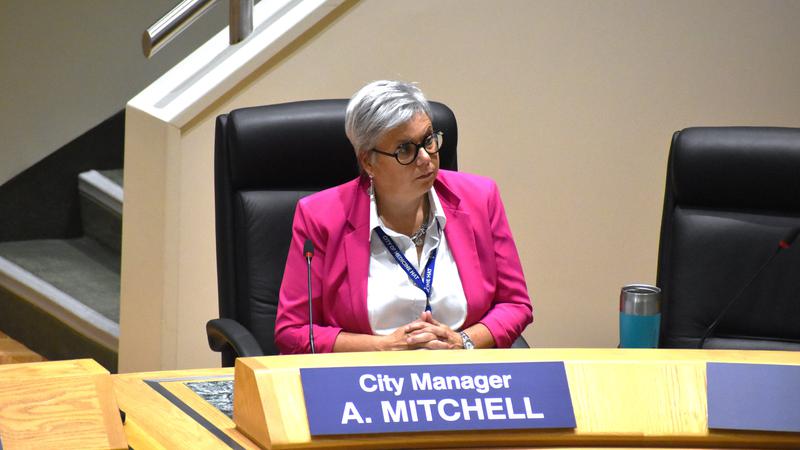
Ann Mitchell, chief administrator of the City of Medicine Hat, listens during a council meeting. Eli J. Ridder/CHAT News
EXCLUSIVE

Medicine Hat CAO criticizes Alberta government, says democracy at threat

May 29, 2025 | 6:02 PM

The City of Medicine Hat’s chief administrator, in a rare public rebuke by a civil servant, is criticizing the Alberta government’s move to eliminate rules policing city councils amid a troubling rise in toxic discourse she says is discouraging people from working in local government.

City Manager Ann Mitchell, who two years ago was the brunt of an exchange with Mayor Linnsie Clark that led to a leadership crisis, says the once-required conduct regulations were wiped too quickly and without consulting public sector workers.

“Codes of conduct are needed but they’re not perfect so I was very concerned Bill 50 came so fast,” Mitchell told CHAT News on Thursday, referencing a provincial bill that made sweeping changes to how municipalities operate.

“Getting rid of codes of conduct without something in place to protect people is very concerning for me.”

A Calgary court last year upheld council’s assertion that Clark broke Medicine Hat’s conduct rules when she pressed Mitchell on her authority to reorganize city hall without explicit council approval.

Council unanimously decided that Clark failed to treat Mitchell with courtesy, dignity and respect and placed crippling sanctions on the mayor that were later removed by a justice who found the restrictions disproportionate.

Ric McIver, then the municipal affairs minister, told reporters to “Google Medicine Hat” when asked for an example of the codes of conduct being weaponized for political gain — his reasoning for getting rid of the regulations.

Mitchell said neither herself, her counterparts or various municipal advocacy groups were consulted by the municipal affairs ministry before the changes.

“It was unfortunate because those of us who were working in the industry really should be consulted more and I don’t think that was done very well,” she said.

Mitchell’s stance puts her at odds with the only two members of council that responded to a request for comment.

Coun. Shila Sharps said that, while she respects the commitment of municipal public servants, the changes to municipal legislation is a “necessary evolution in governance” that “allows municipalities to respond more effectively to community needs.”

“Rather than a step backward, this legislation provides clearer authority for local leadership, enabling decision-making that is both accountable and agile,” Sharps added.

Coun. Andy McGrogen also expressed his support for Bill 50.

Alberta’s new municipal affairs minister Dan Williams said in a statement provided to CHAT News that councillors are accountable to the voters not to other members of council.

“While some councils have seen success with their codes of conduct, we have seen council codes of conduct weaponized by some councils,” Williams said echoing his predecessor McIver.

“This weaponization has resulted in mistrust, dysfunction, and failure to serve Albertans so we’ll be putting codes of conduct on pause.”

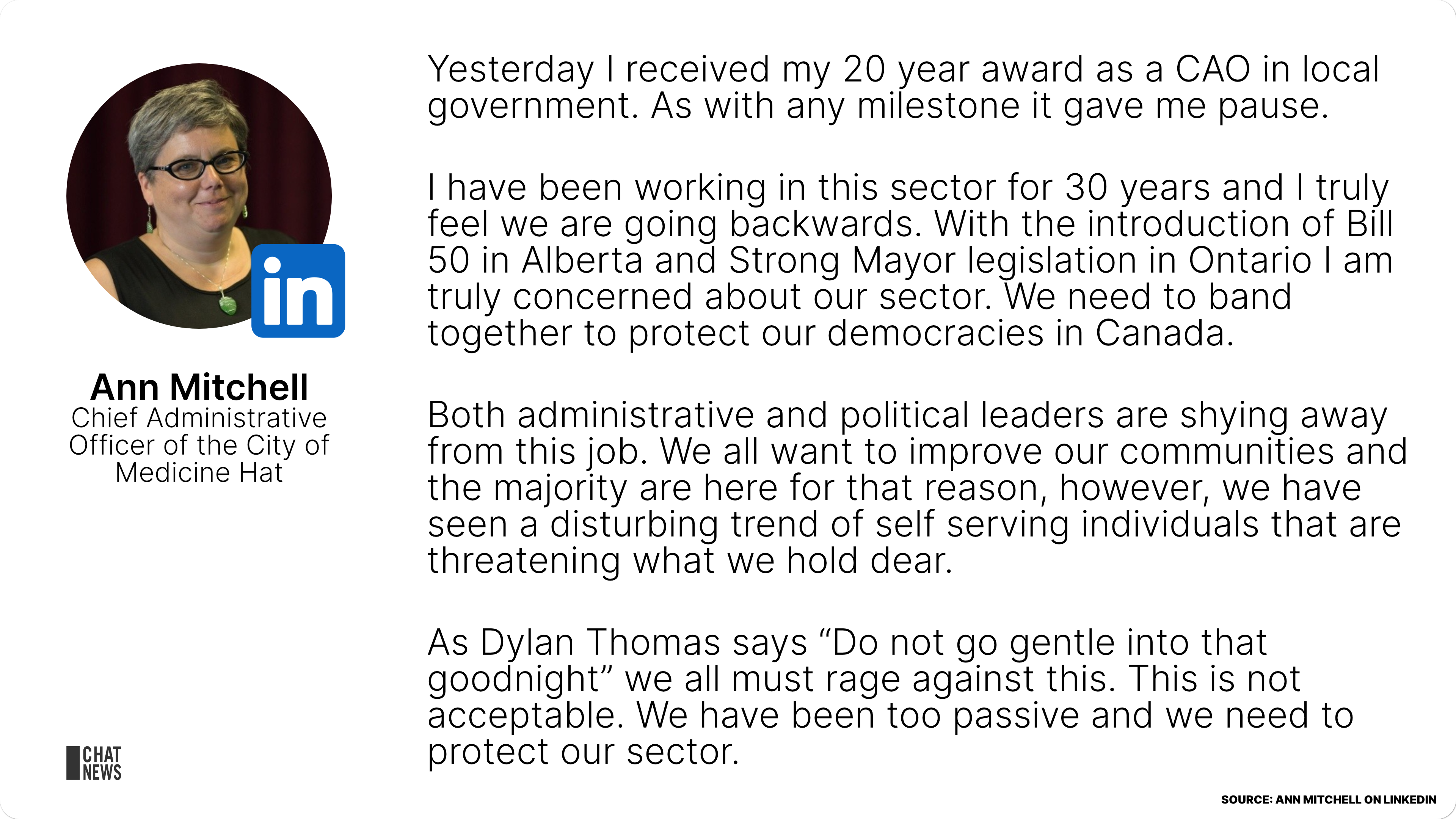
Mitchell granted an interview to CHAT News after she made a LinkedIn post Wednesday blasting Bill 50 and so-called “strong mayor” powers in Ontario that allow councils to be overridden.

Graphic/CHAT News

She wrote that senior administrators countrywide need to work together to protect local democracy across Canada, adding that she’s seen a “disturbing trend of self-serving individuals” that get elected.

The city manager denied that she was talking about any of Medicine Hat’s elected officials — “it’s more themes than about any specific individuals” — and that it’s concern over growing incivility in politics that is driving people away from serving.

“As somebody who’s at the end of my career in local government, I’m really concerned about younger people coming into the profession…I’m worried that we’re going to lose a lot of good people,” said Mitchell.

She said “really good politicians across the country” are stepping away from public service because “people have forgotten to do democratic discourse in a respectful manner.”

Political consultant Jim Groom, a former political science professor at Medicine Hat College, agreed that polite political discourse is now rare but challenged her assertion that democracy is under threat.

“You have to be a little cautious if you go too far and you say, ‘well, democracy is dead’ and the system’s just not working and everything’s broken,” he said.

“Especially when you’re part of the system.”

The chief administrator’s social media post on Wednesday caught some off-guard.

“I have had several community members reach out to me about the message curious about its intent,” McGrogan said in a statement.

The former police chief turned councillor told CHAT News that Mitchell didn’t tell council the thoughts she shared in her post, despite being their main advisor.

“But I can say that Bill 50, in my opinion, has some very good pieces that allows us to serve our communities more effectively, which should be our primary focus at all times,” McGrogan added.

Sharps, without identifying any specific members of council, said elected officials are often rubber stamping proposals from staff.

“Recently, we have seen instances in our own community where municipal leaders are increasingly deferring to administrative recommendations rather than leader decisively,” said Sharps.

“While municipal employees serve their communities with dedication and pride, governance becomes problematic when a few leaders allow their vision to override that of council,” she added.

“This trend has likely been recognized by the Alberta government, prompting swift legislative action to pivot governance structures accordingly.”

Debate between Mitchell and members of council, like the testy exchange in August 2023 with the mayor, often arise because of the conflict between what administration is responsible for and what council has authority over.

Generally, staff are responsible for the daily operations of the city while council sets a strategic vision that it cements through the passing of budgets and other key policies.

Groom, the political observer, said staff aren’t at the whim of council but the city does answer to its residents.

“Politicians do do feel like they’ve been empowered by the system and by the people who elected them,” Groom said in an interview Thursday.

“And the administration is really there to accede to those new policies, procedures (and) approaches that the politicians want to take, and so it’s kind of a delicate balance.”

Mitchell, speaking from Montreal where she is attending a conference with other CAOs from across Canada, said her role is often misunderstood.

“We are council’s principal advisor…you are apolitical but you need to be political,” Mitchell said.

“You need to know enough about the politics side and what’s happening with the changing and shifting legislation.”

Mitchell said councils can be more effective if they receive better orientation — an initiative she’s working on for after the fall civic election.

“We are preparing internally, administratively, to make sure that we have a really good, robust orientation package,” she said.

Mitchell wants to see more advocacy from public servants to save their sector and hinted at a potential task force from the Canadian Association of Municipal Administrators as a next step.

“I do want to make sure that I leave this institution better off than I found it,” Mitchell said.

“There’s a lot of people that are removing themselves from these jobs as public servants both politically and as a bureaucrat, too,” she added.

“It’s not just one or the other, the whole sector is suffering.”