SUBSCRIBE! Sign up for our daily newsletter and never miss a story!

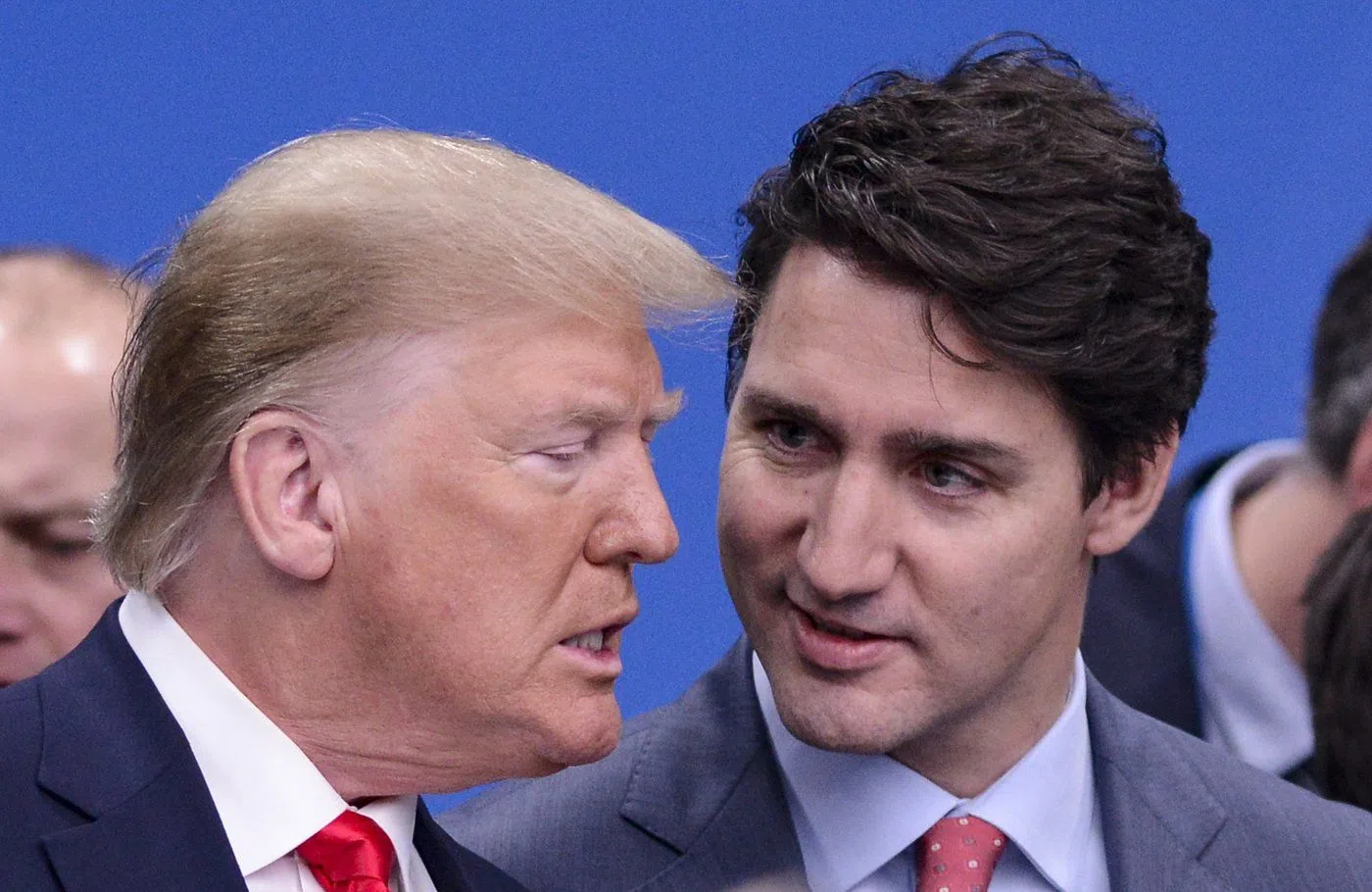
Prime Minister Justin Trudeau and U.S. President Donald Trump arrive to take part in a plenary session at the NATO Summit in Watford, Hertfordshire, England, on Wednesday, Dec. 4, 2019. THE CANADIAN PRESS/Sean Kilpatrick
NATIONAL

Canada receives 30-day tariff reprieve after Trudeau calls Trump

Feb 3, 2025 | 3:50 PM

U.S. President Donald Trump has agreed not to impose tariffs on Canada and Mexico for another month, pulling back from a plan that would have tipped North America into a trade war on Tuesday.

Prime Minister Justin Trudeau spoke with Trump twice on Monday, their first discussions since the president took over the White House on Jan. 20. After what Trudeau described on social media as a “good call” in the afternoon, the two leaders agreed to pause tariffs for at least 30 days.

Trudeau released a statement on X that outlined the broad strokes of the $1.3-billion border plan his government had announced in December, adding that “nearly 10,000 front line personnel are and will be working to protect the border.”

That mirrors the number of troops Mexican President Claudia Sheinbaum pledged to send to the U.S. border on Monday morning when she announced that she had secured a deal with Trump to delay the tariffs on her country by one month.


Trump signed a pair of executive orders on Saturday that laid out a plan to impose 25 per cent across-the-board tariffs on Mexico and 25 per cent tariffs on most Canadian goods, with a lower 10 per cent tariff on Canadian energy.

The executive orders say the levies are a response to illegal immigration and drug smuggling, and use the International Emergency Economic Powers Act to declare an economic emergency that allows Trump to bypass Congress.

The order related to Canada says Mexican cartels are operating in the country and claims the modest amount of fentanyl intercepted at the northern border would be enough to kill “9.5 million Americans.”

Trudeau said Monday that Canada will list cartels as terrorist entities.

“I have also signed a new intelligence directive on organized crime and fentanyl and we will be backing it with $200 million,” he said on X.

Canada plans to launch a joint strike force with the U.S. to combat organized crime, fentanyl trafficking and money laundering, and will appoint a “fentanyl czar” — though Trudeau gave no indication of what that job would entail.

The prime minister did not take questions from reporters on Monday.

Meanwhile, Premier Danielle Smith in a statement to X said “diplomacy has won the day” as she hailed Ottawa and Washington’s joint effort to crack down on criminal activity at the Canada-U.S. border.

“Let us ensure that continues as we know there is much more work ahead of us,” she added.

Trump declared victory in a post on Truth Social, saying Canada agreed to “finally end the deadly scourge of drugs like Fentanyl that have been pouring into our Country, killing hundreds of thousands of Americans.”

But his message ends with a warning that tariffs are not off the table.

“I am very pleased with this initial outcome, and the Tariffs announced on Saturday will be paused for a 30 day period to see whether or not a final Economic deal with Canada can be structured,” Trump wrote, finishing with “FAIRNESS FOR ALL.”

The 30-day pause does mean that Canada’s counter-tariffs are also on hold. Several provinces were scrambling late in the day to reverse plans to implement non-tariff measures, such as barring the sale of American liquor and removing all U.S. alcohol.

Ottawa’s retaliation plan was set to begin with an initial 25 per cent tariff on $30 billion in U.S. goods on Tuesday, with tariffs on another $125 billion worth of goods three weeks later.

The late-day news of a pause came after markets closed after a difficult Monday. Canada’s main stock index, the S&P/TSX composite, was down nearly 300 points at the closing bell, while the loonie fell to its lowest level in more than two decades.

It also came after another day of shifting rhetoric from the White House.

Trump’s stated rationale for the tariffs — the need to end the flow of drugs and migrants into the U.S. — is tied to the emergency order he signed, but he has also said he wants to end the U.S. trade deficit with Canada.

Between calls with Trudeau on Monday, Trump lamented to reporters in the Oval Office that Canada has been “very tough to deal with” and “very unfair.”

When asked whether there was anything Trudeau could offer him to get him to back off the threat, Trump went back to another now-familiar line.

“What I’d like to see? Canada become our 51st state,” he said, adding “we don’t need them for anything.”

Ontario pauses retaliatory measures

Premier Doug Ford said Ontario will pause all retaliatory measures against the United States, with news that the threat of tariffs has been put on hold for a month.

Ford said the province’s main liquor store will no longer remove American alcohol from its shelves.

The province will also pause the cancellation of a $100-million deal with Elon Musk’s SpaceX to deliver high-speed internet to remote areas via Starlink satellite technology.

Ford is also in the middle of campaigning as Progressive Conservative leader in a $189-million snap election he called last week.

Ford said the retaliatory measures remain on the table should Trump impose tariffs at any point.

Economic emergency

Trump relied upon the International Emergency Economic Powers Act to declare an economic emergency that allowed him to bypass Congress and impose the tariffs on his own.

The executive orders say the levies are a response to illegal immigration and drug smuggling. The order related to Canada says Mexican cartels are operating in the country and claims the modest amount of fentanyl intercepted at the northern border would be enough to kill “9.5 million Americans.”

Trump also has said repeatedly he thinks tariffs are “beautiful” and claims they can make the U.S. wealthier, despite the short-term pain for businesses and consumers.

The move sparked concern and condemnation from American business and labour groups, including the National Association of Homebuilders, the United Steelworkers International and the U.S. Chamber of Commerce, among others.

“The imposition of tariffs under IEEPA is unprecedented, won’t solve these problems, and will only raise prices for American families and upend supply chains,” John Murphy, the chamber’s senior vice-president and head of international, said in a Saturday statement.

Both Canada and Mexico promised to strike back with counter-tariffs over the weekend.

Ottawa’s counter-tariff plan would have begun on Tuesday with 25 per cent tariffs on $30 billion in goods originating in the U.S.

In three weeks, after consulting with industry, the federal government plans to impose tariffs on another $125 billion in U.S. goods.

Trudeau said additional non-tariff measures are being discussed by the federal and provincial governments, including some related to critical minerals, energy and procurement.

Green Party Leader Elizabeth May said in a statement Monday morning that Trudeau met with opposition leaders to discuss his government’s response to the tariff threat.

“The prime minister shared that it had become increasingly clear that there was no evidence or further actions on border security that would make any difference. Trump would only double down. It was not really about fentanyl. It was about Canada and our sovereignty,” she said.

Premiers have laid out plans for their own countermeasures. Several provinces have pledged to stop buying U.S. alcohol and to remove it from the shelves of provincial liquor stores.

Ontario Premier Doug Ford, who is in the midst of an election campaign, announced that he will bar American companies from provincial contracts as long as the tariffs are in place.

He also said he ripped up a $100-million deal with SpaceX’s Starlink to bring internet to rural and northern communities. The company is owned by Trump donor Elon Musk; the president has tapped Musk to lead a government efficiency agency.

“I’m not going to support someone that is hell-bent on destroying our province, destroying people’s families, taking jobs away from them,” Ford said at a campaign announcement on Monday.

Saskatchewan Premier Scott Moe on Monday called for Canada to send troops to the border to stop illicit drugs from crossing into the U.S.

He said securing a delay in the tariffs would allow Canadian leaders to make a case to stop them altogether.

In a press conference, Moe also repeated his proposal to make the Canada Border Services Agency a part of the military and said he’s asked Public Safety Minister Dominic LeBlanc to consider whether that’s possible.

Such a move likely would require changes to federal laws, and Parliament is prorogued until late March while the Liberals choose a new leader to replace Trudeau.

Conservative Leader Pierre Poilievre also called for the government to send Canadian Armed Forces troops and helicopters to the border.

In a social media post, Poilievre said Canada should also add thousands of border agents and “extend CBSA powers along the entire border, not just crossings.”