SUBSCRIBE! Sign up for our daily newsletter and never miss a story!

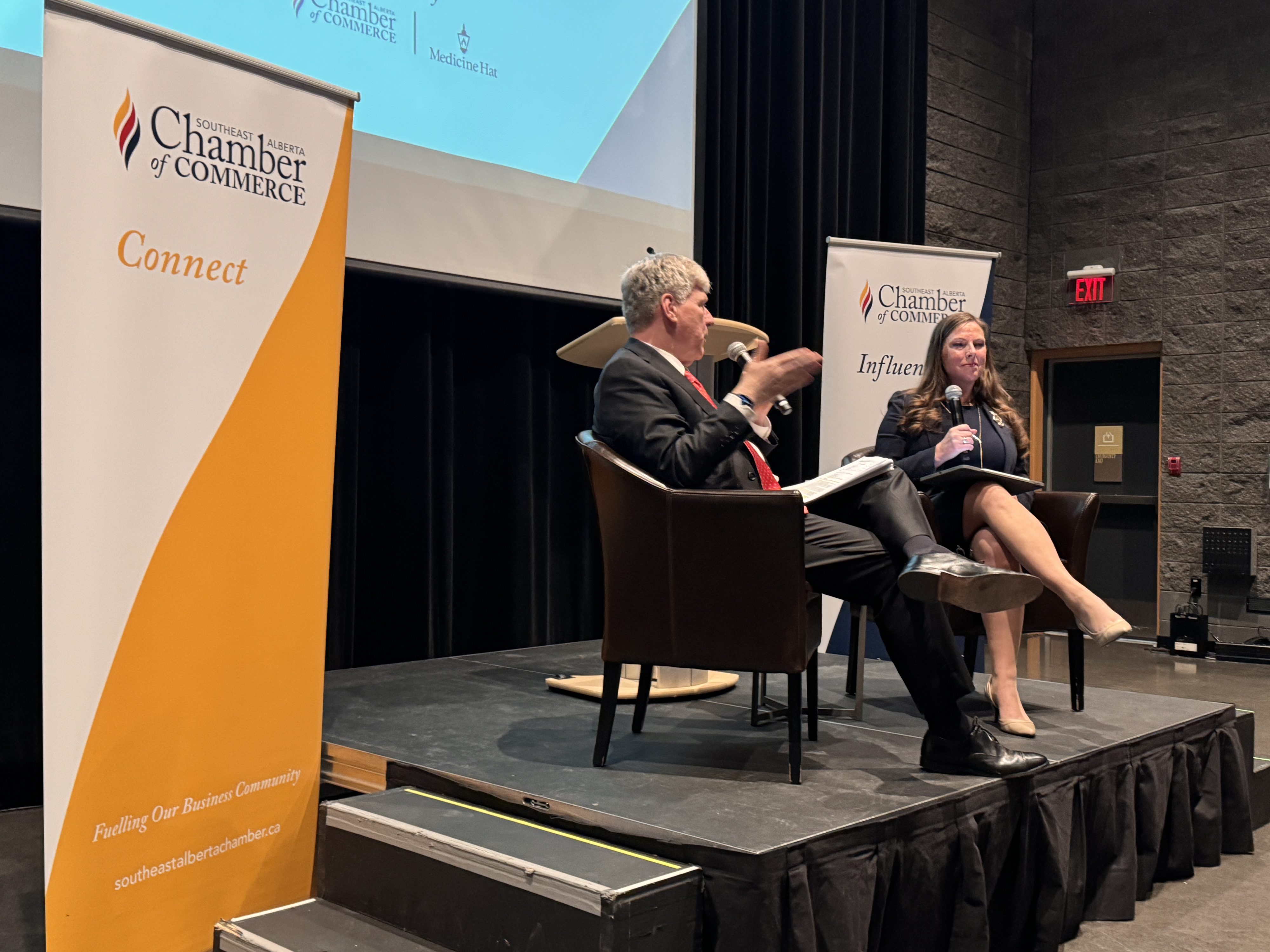
Federal Energy and Natural Resources Minister Tim Hodgson spoke with the City of Medicine Hat managing director of energy, land and environment, Rochelle Pancoast at the Southeast Alberta Chamber of Commerce event ”Canada's Energy Future: A Conversation with Minister Tim Hodgson.” (Image Credit: Jesse Gill/CHAT News)
Budget 2026

Federal Energy Minister Hodgson highlights SE Alberta investment opportunities during Medicine Hat visit

Nov 12, 2026 | 2:16 PM

Federal Energy and Natural Resources Minister Tim Hodgson said Canada needs to turn its natural resource advantages into investment, infrastructure and jobs as the country looks to strengthen its economic independence.

Hodgson made the comments Thursday during a Southeast Alberta Chamber of Commerce event in Medicine Hat titled “Canada’s Energy Future: A Conversation with Minister Tim Hodgson.”

The discussion, moderated by City of Medicine Hat managing director of energy, land and environment Rochelle Pancoast, focused on Canada’s energy strategy and opportunities for businesses and communities across the region.

Hodgson pointed to Medicine Hat’s history of using natural gas to attract industry, saying the city’s decision more than a century ago to retain control of its gas resources and develop a municipal utility helped build its manufacturing economy.

He said that history offers a lesson for Canada as it looks to develop its resources, attract private capital and expand its markets.

“Canada must move from potential to production, from ambition to investment and from talking about the projects Canada needs to getting those projects built,” Hodgson said.

—

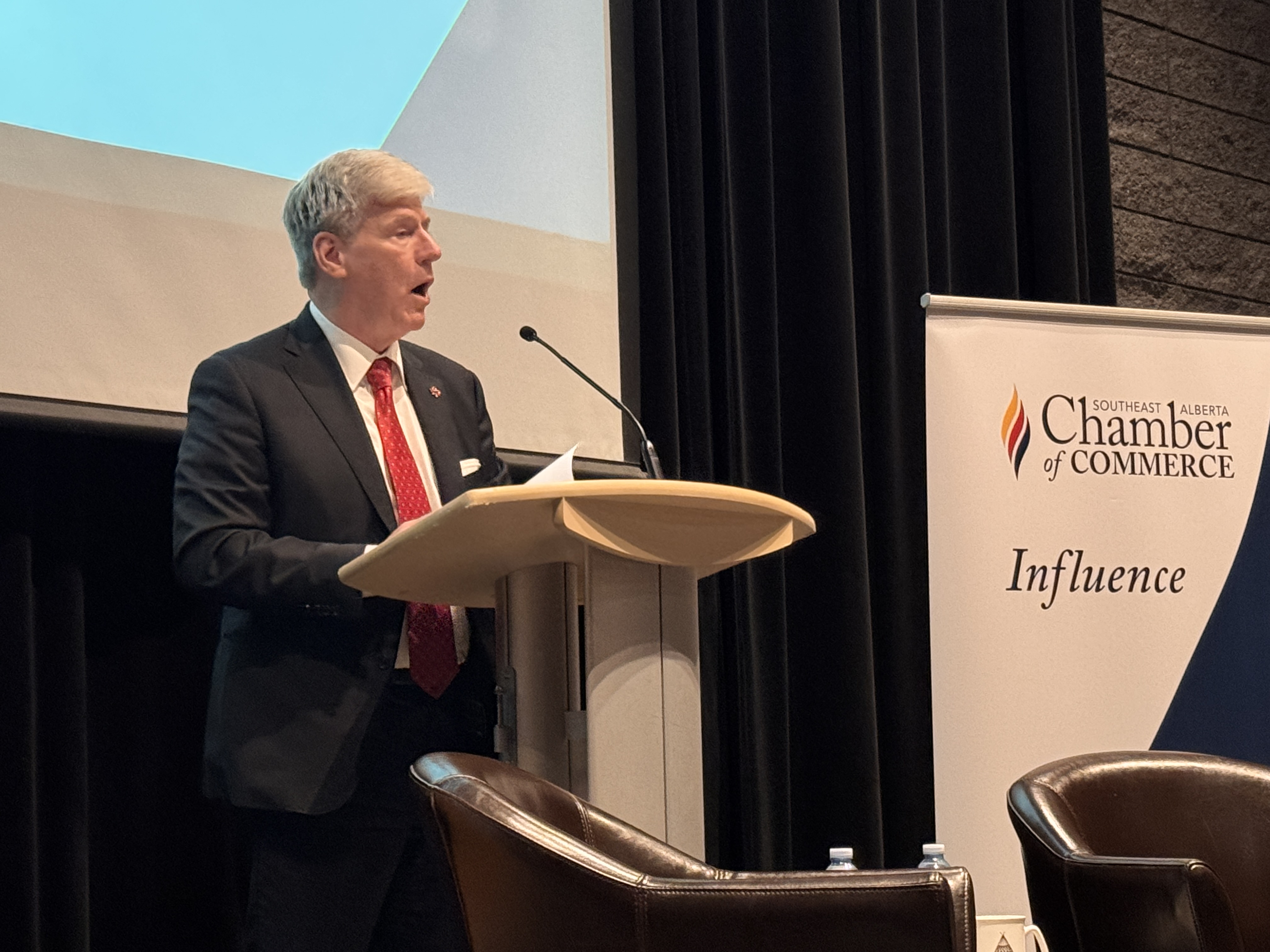
Federal Energy and Natural Resources Minister Tim Hodgson speaking during the Southeast Alberta Chamber of Commerce event, before the sit-down portion.
Federal Energy and Natural Resources Minister Tim Hodgson speaking during the Southeast Alberta Chamber of Commerce event, before the sit-down portion. (Image Credit: Jesse Gill/CHAT News)

He highlighted measures in the federal government’s 2026 budget aimed at making Canada more attractive to investors, including a new productivity mega deduction that allows businesses to immediately deduct the full cost of most new investments.

Hodgson said the measure is expected to reduce Canada’s marginal effective tax rate on new business investment from 13 per cent to 6.4 per cent, which he described as the lowest in the G7.

The federal government estimates the measure could add about $22 billion annually to Canada’s gross domestic product over the next decade and help create as many as 80,000 jobs.

Southeast Alberta Chamber of Commerce President Aaron Fleming said the change could make a significant difference for small and medium-sized businesses looking to invest in new equipment, technology or infrastructure.

“That’s a massive impact,” Fleming said.

“When you start looking at the small dollars and the small profits that companies would have, and to be able to have a little bit more money in their pockets.”

Fleming acknowledged the outlook for businesses remains uncertain, but said he hopes companies will view the budget as a reason to be optimistic about the future.

“I myself have some good hope for the future within Canada, some good hope for the business community,” Fleming said.

He added that continued advocacy will be important to ensure governments address the challenges businesses face and create conditions that support growth.

Hodgson also pointed to a Canada growth incentive, changes to small-business rollover provisions and an expansion of the scientific research and experimental development program.

He said the measures are intended to encourage businesses to invest, expand and keep more economic activity in Canada.

Energy was a central focus of the discussion, with Hodgson saying growing global demand for oil, natural gas, uranium and electricity presents an opportunity for Canada, particularly Alberta.

He said the federal government is advancing 28 nation-building projects through its Major Projects Office, representing nearly $500 billion in potential private-sector investment.

The government has 18 of those projects listed publicly on its website.

Those initiatives include a proposed pipeline to move at least one million barrels of Alberta oil per day to Asian markets, plans to increase liquefied natural gas exports and investments in nuclear energy.

Hodgson also discussed the federal government’s first national electricity strategy, which aims to double Canada’s electricity grid to meet growing demand.

Budget 2026 commits more than $50 billion toward electricity infrastructure, he said, adding that stronger transmission connections between Alberta, British Columbia and Saskatchewan could help the province expand renewable energy production.

During the moderated discussion, Hodgson was asked about opportunities to increase natural gas pipeline capacity in Alberta, including concerns about lengthy timelines for businesses seeking additional access to the NGTL system.

He acknowledged challenges with the system’s expansion and said the federal government, Alberta government and pipeline operator were discussing ways to increase capacity.

“We’re all alive to the issue,” Hodgson said, adding he was optimistic major expansions of Alberta’s natural gas system would be seen in the near term.

The minister also highlighted the potential for carbon capture, utilization and storage technology and fuel cells to support industrial growth while reducing emissions.

He said advances in solid oxide fuel cells could allow Alberta natural gas to generate electricity while producing a concentrated stream of carbon dioxide that could be captured and stored more economically.

Hodgson said he would like to see more of Alberta’s natural gas used within the province to power industries, generate electricity and support emerging sectors such as artificial intelligence and data centres.

He said data centre developments should be located behind the meter to ensure they do not affect electricity rates, and should be developed in consultation with local municipalities.

When asked about attracting international investment, Hodgson pointed to the importance of regulatory certainty, saying businesses need confidence that policies will remain predictable over the life of a project.

He said the federal government was working toward an approach that supports conventional energy development while advancing emissions reductions, adding that regulatory stability is important for long-term investment decisions.

Looking five years ahead, Hodgson said he hoped to see more natural gas used in Alberta, greater development of value-added industries, expanded carbon capture projects and additional renewable energy generation.

He also said stronger electricity connections could help Alberta make better use of its wind and solar resources.

For Southeast Alberta, Hodgson identified natural gas production, agriculture and agri-food processing, manufacturing, energy services and emerging electricity-intensive industries as areas with growth potential.

He said the region’s existing industrial base, transportation connections, workforce and natural resources give it a competitive advantage, but businesses and governments will need to work together to turn those assets into investment.

“Your government cannot do it alone,” Hodgson said.

“The investment super cycle will not happen without your help.”

The event was held in partnership with the City of Medicine Hat.

—

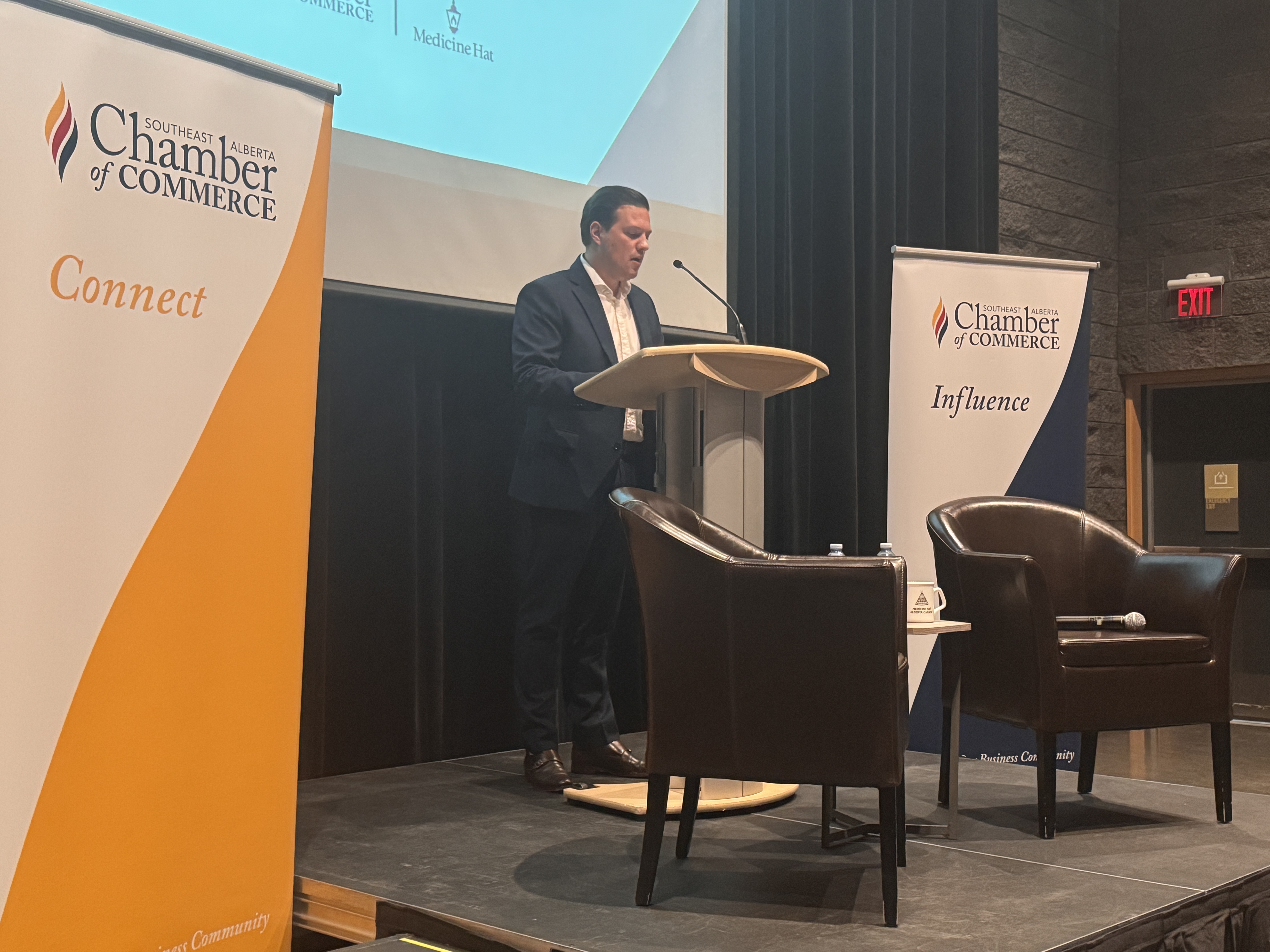
City Manager Joe Hutter spoke briefly during the Southeast Alberta Chamber of Commerce event.
City Manager Joe Hutter spoke briefly during the Southeast Alberta Chamber of Commerce event. (Image Credit: Jesse Gill/CHAT News)

City Manager Joseph Hutter also welcomed Hodgson, noting the community’s long-standing relationship with energy and its potential role in Canada’s future energy development.

Fleming said bringing federal decision-makers to Medicine Hat gives local businesses an opportunity to share their concerns and highlight the region’s potential.

“I think it’s great that we have the opportunity as Medicine Hat to attract federal government here to be able to have a conversation,” Fleming said.

He said the Chamber continues to advocate for policies that reduce barriers for businesses, improve investment conditions and make it easier for existing companies to expand.