SUBSCRIBE! Sign up for our daily newsletter and never miss a story!

File Photo/CHAT News
Agriculture

Growing season has presented challenges for Cypress County farmer Neubauer

Oct 10, 2025 | 7:23 AM

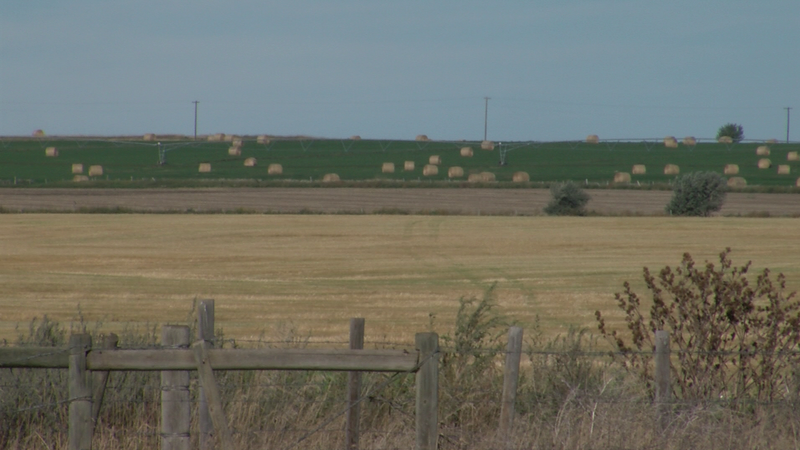
Cypress County farmer Nichole Neubauer and her family at Neubauer Farms finished harvest on the last day of September.

They are included in a large number of producers who have wrapped up for the season, with the Alberta Crop Report on Sept. 29 showing that 91.4 per cent of major crops were off the field in southern Alberta.

The south is a little ahead of the 89.1 per cent that the rest of the province’s farmers had averaged to that point.

Neubauer said that this year presented a lot of challenges for producers like her in the southeast corner of the province.


“All the way back to spring seeding, we were quite optimistic and hopeful when we put the crop in the ground, we had some good subsoil moisture and some residual moisture from a wet fall,” Neubauer said.

“The crop went in and germinated and looked really good. And then the tap turned off.”

A lack of precipitation for dry land farmers in May and June put crops in the area under stress.

“Any of the seeds that were near the surface were in dry material and failed to germinate. It was really spotty in places as well, where it was a little drier,” Neubauer said.

“Then the craziness happened because we flipped the switch in July and August, which became unseasonably cooler with a lot of precipitation,” she added.

“Crops that had been sitting there with seeds dormant in the soil since planting time, all of a sudden decided to germinate.”

The result, according to Neubauer, was two-month stages of development within the same crop.

“Anything that germinates late in July is out of sync with the heat and the sun and all of the cycles. So we were at the end waiting, painfully waiting for things to mature and ripen,” Neubauer said.

“The portions of the crop that already had matured, the quality of that was being degraded while we waited for the other to mature,” she added.

“It was quite challenging.”

The Neubauers would harvest in three months of the year in 2025, during July, August and September.

“It’s a good one to pull the pin on and be done with. Yields were very poor in the dry land,” Neubauer said.

“Even in the irrigation land, even though we can facilitate the water supply through the pivots, nothing beats rain,” she added.

“You could see the stress in the irrigation crops as well because of the lack of precipitation early on.”

Yields for the crops were less than half of normal, and the quality was poor.

“Because of the different stages of development, and some that was quite mature. It resulted in bleach or even just shelling out and falling on the ground,” Neubauer said.

“Then, some that developed a little bit later on, there was a lot of immature seeds in the sample and even some green.”

This devalued the crops significantly, as the crop will need to be mixed in with a higher-graded crop by the grain terminal.

“The lentils were a three, and that can have a fairly significant impact on what they’re going to pay for it. And I mean, we really haven’t marketed anything at this point because basically there is no market for the crops,” Neubauer said.

“We’ll wait and see where they settle out once we want to start talking about some contracts. But at this point, we’re not selling anything because of a number of geopolitical tariffs,” she added.

“They’re having a really severe and immediate impact on crop producers in this region right now.”

The Neubauers grew lentils, durum, canola and peas this year.

She said the durum was very poor and the peas grown on irrigated land were a two, which is normal.

A good Canola sample, but a crop lacking a strong yield, mixed with tariffs, has put Canadian producers in a tough spot.

China imposed a 75.8 per cent anti-dumping duty, essentially a tariff to shut Canadian producers out of the market.

“70% of our canola goes to China. We’ve lost our biggest customer, and that’s caused the prices to tank. So obviously that’s a huge concern,” Neubauer said.

“The Chinese government has also imposed 100% pea tariffs, which is eliminating the destination of 30% of Alberta peas as well,” she added.

“These tariffs are seen as a retaliation for the Canadian measures imposed on electric vehicles from China. As a producer, it’s incredibly frustrating because we feel like we’re basically caught in the crosshairs of a government dispute, which every day that this goes on is placing farm families and rural communities at great risk.”

The situation has left producers with little control.

“We’re not really hearing a lot of leadership from Ottawa. I think our premiers they’ve done a decent job of advocating, but ultimately the change needs to happen at the top,” Neubauer said.

“I feel very uncertain and very nervous about the future of agriculture because it doesn’t seem to be garnering the kind of attention that it should.”

With two of the four crops grown subject to international trade disruptions, Neubauer will remain with the crop rotation.

“You have to stick with your rotations because the bumps along the way with markets and the volatility of markets, most of it is usually temporary. So you can’t change your plans and your rotation plans to chase something, which at this point, actually nothing is good,” Neubauer said.

“Wheat is below $7 a bushel. Just to put that in context, that’s about what wheat was selling for in the 70s or 80s. With the cost of inputs skyrocketing, sky rising and all of the cost of equipment and land, the mass just isn’t massing these days,” she added.

“As a food-producing nation, we really rely on strong trade relationships and trade partners.”

Neubauer adds that the crop rotation they have is helpful for the land, with each different crop using different nutrients and leaving different things behind.

The amount of acres harvested in the spring is what could see the biggest impact.

“We need to maybe change some of the ratios of what we’re growing, but also selling $6 a bushel wheat isn’t going to keep the lights on for producers either,” Neubauer said.

“We need action, and we definitely need a country that wants to talk about agriculture loud and proud. And the world really, the world does rely on Canadian agriculture, and we need some leadership to help sustain our industry.”

Finding and developing local supply chains is something Neubauer said would help support local farmers.

“A huge opportunity for our region is that I believe there’s a great chance to take all of the incredible commodities that we grow here and set up processing and add value to those products to make them something that the consumer can buy,” Neubauer said.

“Selling raw products to someone else to add value to and make all the profit on it isn’t a great business model,” she added.

“If we could feed more Canadian products through value-added industry, that’s where we could actually see a return on our dollar, and we could create more demand for the products that we grow here.”

Neubauer said there is very little in the area in terms of actual processing of these products.

“Whether it’s turning field peas into a plant-based protein that can be sold as a protein additive or whether we’re growing fields of pumpkins and processing that into pumpkin purees that can be sold for end use,” Neubauer said.

“There are lots of opportunities to do a better job of refining what we have locally,” she added.

“I really want to highlight that may be a key path forward.”

That needs to become a talking point for serious economic development growth for the region, according to Neubauer.

“As far as a corridor, we’re part of that. We just need to grow up and put our big boots on and realize that it’s ours to take advantage of, and everything these days gets transported,” Neubauer said.

“The logistics can be managed. It’s just a matter of creating that product that there’s demand for,” she added.

“If we feed all the Canadian mouths first, that would go a long way to insulate us from some of the trade repercussions that happen.”

One of the positives for a producer like Neubauer is that they have a herd of about 55 pairs of cows and calves.

“The cattle market is on fire right now. And as an operator that has that level of diversity, we’re pretty thankful that there is some optimism,” Neubauer said.

“The fall run is about to start here, and we’ll be marketing our calves. We’re hoping that the market holds and definitely that’s gonna help pay some bills and look after keeping the lights on here at the farm this year,” she added.

“Where the cattle are at this year, it’s excellent because [there’s] lots of overhead raising cattle and lots of stress, lots of responsibility. It’s great to see producers have a decent pay window this year.”

Growing a larger herd to benefit does present some challenges for producers.

“Grass and recent drought conditions are a limiting factor for that because you gotta be able to feed them all summer long,” Neubauer said.

“All growth has to happen in a way that can be sustained by the land, and the land is always the priority.”

The reason for the high cattle prices, according to Neubauer, is that the total cattle numbers in North America are below demand.

“There are just not as many mama cows out there having calves,” Neubauer said.

“This type of market does motivate people to grow their herds if they have the grass for it.”