SUBSCRIBE! Sign up for our daily newsletter and never miss a story!

(rdnewsNOW/ Ian Gustafson)
12 per cent over 4 years

AUPE and provincial government receive mediator’s recommendation, ratification vote imminent

Aug 28, 2025 | 11:03 AM

The Alberta Union of Provincial Employees (AUPE) and the Government of Alberta have received the mediator’s recommendations for a settlement that would form a new collective bargaining agreement if it is ratified by both parties.

As a result, the Government Services Bargaining Committee (GSBC) will hold a ratification vote from Friday, Aug. 29 at 9 a.m. to Wednesday, Sept. 3 at 4:30 p.m. for AUPE members.

The vote will only be happening online through members’ MyAUPE accounts.

In an update on the AUPE website, they wrote that if the majority vote yes, there will be a new collective agreement, however, If the majority vote no, AUPE members will go on strike before Sept. 9.


rdnewsNOW contacted the AUPE, but the union said they will not be commenting on what has happened in enhanced negotiations for a new collective agreement with the Government of Alberta at this time. They are giving their members time to examine what they called a very complex proposal before making any comments.

Meantime, President of Treasury Board and Minister of Finance Nate Horner said in a statement that these recommendations are a result of months of dedicated negotiations between the two parties.

“I want to thank the AUPE for their collaboration in working to bring a resolution to this round of bargaining,” he said. “Alberta’s government values and appreciates the hard work of the 22,000 employees who are members of the AUPE and I look forward to the results of the ratification vote.”

The full report of the mediator’s recommendations can be found here, but in short, the term would be from April 1, 2024 to March 31, 2028.

Highlights of the recommendations include:

  • General Salary Increase: three per cent increase April 1, 2024 (retroactive); three per cent April 1, 2025 (retroactive); three per cent April 1, 2026; three per cent April 1, 2027.
  • Grid Adjustment: Some grids are adjusted to ensure there is a minimum of four per cent between steps.*
  • Market adjustments: Effective on date of ratification, certain classifications will receive various levels of market adjustments.*
    *Classifications that are eligible for a market adjustment are listed in paragraph 9 of the Mediator’s Report. Classifications affected by the Grid Adjustment to a minimum of four per cent between steps are listed in Appendix “B” of the Mediator’s Report. Some classifications are eligible for both.
  • Classifications below the living wage of $22.65/hour will be adjusted to that level on date of ratification.
  • Long Service Increment: Effective on date of ratification, a two per cent salary increase upon reaching 20 years of service by date of ratification or when you reach 20 years during the life of the agreement.
  • Flexible Spending Account: Effective April 1, 2026, an increase by $300 to a total of $1200 annually.
  • Additional Paid Holiday: Effective on date of ratification, includes any other holiday proclaimed by the governments of Canada or Alberta.
  • Additional Personal Day: Effective on date of ratification.
  • Recruitment, Attraction and Retention fund: Effective on date of ratification, a fund of $11.4 million annually with a 4% increase each year, jointly administered between GoA and AUPE, to provide additional incentives in areas that are facing recruitment and retention issues.

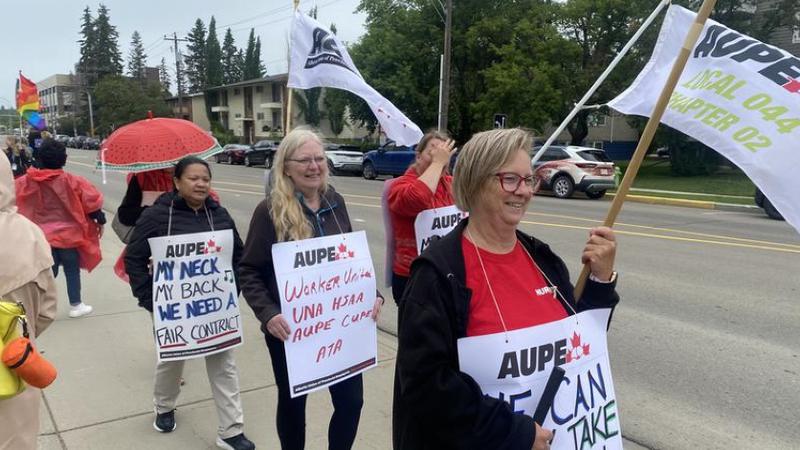
AUPE members at the Red Deer Regional Hospital have held multiple rallies outside the facility throughout negotiations, most recently in July. Others have been held around the province.

Members at a Red Deer rally lamented the employer’s refusal to budge off a 7.5 per cent increase over four years.

The recommendations would give them 12 per cent over that span.

AUPE members at the Red Deer Regional Hospital are made up of roughly 1,500 people in general support services and approximately 700 health care aides and nurses. There are 136 classifications under general support.